Skip to content
  • NSW-first CPD, built by a practising builder
  • Instant PDF certificates
  • Unlimited assessment attempts
  • 12 points a year, sorted
  • 15% off your first order — get your code
  • Content aligned to the NCC 2022

Free template Safety and WHS

Free hazardous chemicals register and SDS register

List every hazardous chemical on site with its current safety data sheet, quantity, storage location, hazards, PPE and first aid, so workers and emergency services can find it fast.

The short version

If hazardous chemicals are used, handled or stored at a workplace, the business must keep a register listing each chemical with its current safety data sheet (SDS), keep it up to date, and make it readily accessible to workers and emergency services. On a building site that typically includes fuels, solvents, adhesives, sealants, form oils, concrete additives, cleaning acids and gas cylinders.

  • No sign-up
  • Free for commercial use
  • Add your own logo
  • Updated 14 Sep 2026

Reviewed by Daniel Betros, Licensed Building Practitioner

Animated walkthrough · 6 steps

How to set up a hazardous chemicals register

Six steps. Do the walk-around once properly, then keep it current every time a product arrives or leaves.

1 / 6
  1. Name the person responsible for keeping it current and where the register and SDS are kept on site. Emergency services need to find it quickly.

  2. Check the site shed, containers, utes and trade storage. Fuels, solvents, adhesives, sealants, primers, form oil, curing compounds, acids and gas cylinders are usually there.

  3. Get the safety data sheet from the manufacturer or supplier. Check it is the current version. No SDS, no product on site.

  4. Note the hazard class, the approximate maximum quantity on site and where it is stored. Keep incompatible chemicals apart and flammables away from ignition sources.

  5. Pull the PPE, first aid and spill steps from each SDS so a worker can see them at a glance, and keep the full SDS with the register.

  6. Use the storage checklist, update the register when products arrive or leave, and review it at least at each stage of the job.

Building sites carry more hazardous chemicals than most builders realise: petrol and diesel for small plant, solvents and thinners, construction adhesives, sealants and primers, form oil and curing compounds, concrete additives, brick-cleaning acid, and gas cylinders. The law asks for a simple thing in return: know what is on site, have the safety data sheet for each, and make both easy to find. This register does that on one page.

What the law requires

Where hazardous chemicals are used, handled or stored at a workplace, the WHS Regulations require the business to:

  • keep a register listing each hazardous chemical, with its current safety data sheet;
  • keep the register up to date; and
  • make it readily accessible to workers involved in using, handling or storing the chemicals, and to anyone else likely to be affected, including emergency services.

There are also duties to manage the risks of each chemical, to label containers correctly (including anything decanted), and to store chemicals safely. Where chemicals are stored above certain quantities, further requirements such as a manifest and placarding apply; most residential sites are well below those, but check if you store fuel or gas in bulk.

Safety data sheets: what they give you

A safety data sheet is prepared by the manufacturer or importer and tells you the hazards of a product, how to handle and store it, what PPE to wear, first aid, what to do with a spill and how to dispose of it. Suppliers must provide them. Keep the current version; if the one on file is years old, get a new copy. Columns in the register pull out the parts a worker needs at a glance, but the full SDS must be there too.

Finding everything on site

The first time, do a proper walk-around: the site shed, the container, the back of each trade’s ute and trailer, under the house if there is one. Subcontractors bring their own products; they belong on the register while they are on your site. After that, update the register as products arrive and leave. The site induction is a good moment to ask each trade what they are bringing.

Storage basics that prevent most incidents

  1. Flammables away from ignition sources, in a suitable cabinet or ventilated area, and never beside hot work.
  2. Gas cylinders upright and secured, in a ventilated area, with valves protected.
  3. Incompatible chemicals apart. Acids away from alkalis and oxidisers.
  4. Everything labelled, especially decanted fuel and cleaning acid in unmarked bottles.
  5. A spill kit suited to what is on site, and an eye wash where corrosives are used.

Silica: not a chemical on the shelf, but a hazard you create

Crystalline silica is in concrete, bricks, tiles, fibre cement and natural stone. It becomes a serious health hazard when those materials are cut, ground or drilled, releasing fine dust that causes silicosis. The use of engineered stone benchtops, panels and slabs has been prohibited in Australia since 1 July 2024, with limited exceptions. For other silica-containing materials, control the dust at the source, and cover it in the risk assessment and the SWMS.

Keeping it useful

A register nobody can find in an emergency does not meet the requirement. Tell people where it is at induction, keep it in the site office with the emergency plan, and review it at least at each stage of the job. Link it to your hot work permits so flammables are moved before work starts.

Common construction products and their main hazards

Product typeTypical hazards to check on the SDS
Petrol, diesel, two-stroke mixFlammable; vapour; skin irritation
Solvent-based adhesives, primers and thinnersFlammable; vapour in enclosed spaces; skin and eye irritation
Polyurethane foams and sealantsRespiratory sensitisation from some products; eye and skin irritation
Cement, mortar and concreteAlkaline burns to skin and eyes; dust containing crystalline silica when dry
Brick and paver cleaning acidsCorrosive to skin and eyes; fumes; reactions with incompatible chemicals
Form oils and curing compoundsSkin irritation; some flammable
Gas cylinders (LPG, acetylene, oxygen)Flammable or oxidising gas under pressure; cylinder handling

This is a guide to what to look for, not a substitute for the product’s own SDS, which is the authority for that product.

Decanting and labelling

A surprising number of chemical injuries on site come from unlabelled containers: fuel in a drink bottle, acid in an old detergent container, thinners in a cup. Decanted chemicals must be labelled with at least the product name and its hazards. The simplest rule is: decant only into containers made for the purpose, label them immediately, and never use food or drink containers. Include it in the site induction and your weekly site safety inspection.
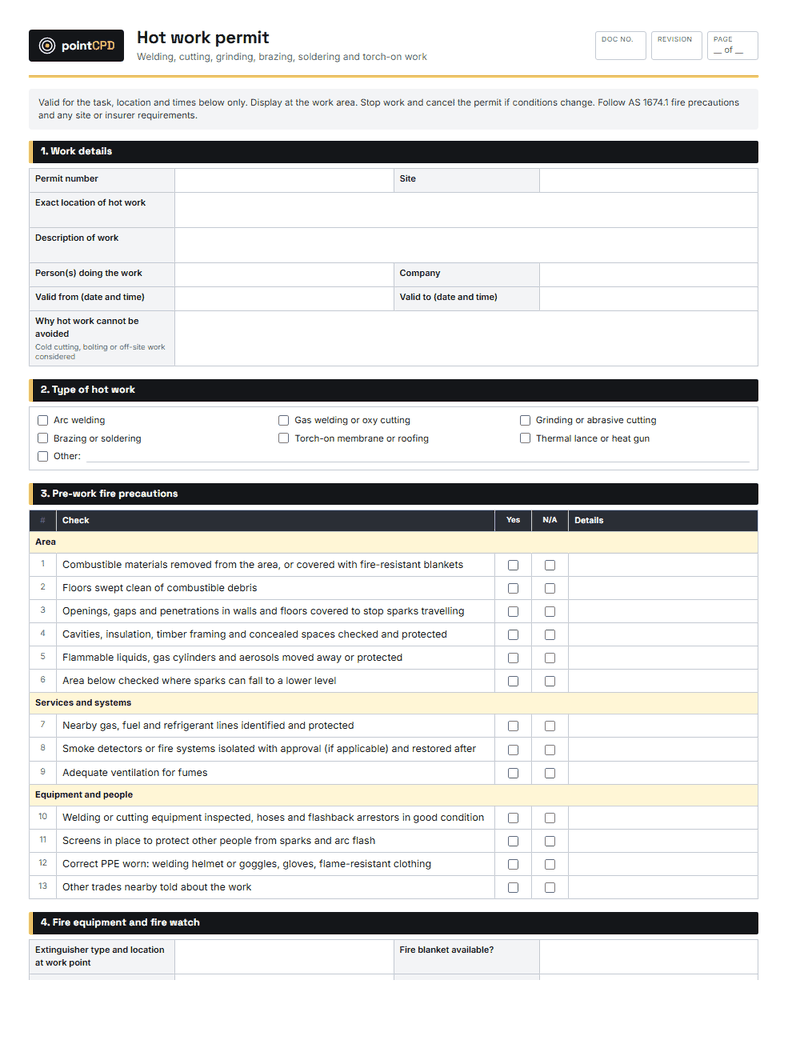
Preview the full Hazardous chemicals register template

Every section, field and check in the download, exactly as it prints. Edit the Word version to add your logo, delete what does not apply and add your own site-specific items.

pointCPD

Hazardous chemicals register

Products on site with safety data sheets

Doc no.
Revision
Page
__ of __

Keep this register and the current safety data sheet (SDS) for every product listed in an accessible location on site. Update it when products arrive or leave. Emergency services must be able to access it.

1. Site details

Site / projectRegister kept by
Location of register and SDS on site
Poisons informationLast reviewed

2. Register

Product nameSupplierUsed forHazard classification / pictogramsMax qty on siteStorage locationPPE requiredSDS date (current?)Risk assessed?
ExampleUnleaded petrolService stationSmall plant fuelFlammable liquid; toxic20 LFlammables cabinet, shedGloves, eye protectionYes
ExampleAcetylene cylinderGas supplierOxy cuttingFlammable gas under pressure1 cylinderUpright, chained, ventilated cageWelding PPEYes

3. Storage and handling checks

#CheckYesNoN/AComments / action
1Current SDS available for every product on site
2Containers labelled correctly; decanted containers labelled too
3Flammable liquids stored in a suitable cabinet or area away from ignition sources
4Incompatible chemicals stored apart
5Gas cylinders upright, secured and ventilated, valves protected
6Spill kit suitable for the chemicals on site, stocked
7Eye wash available where corrosives are used
8Quantities kept to what the job needs
9Workers trained on the hazards and SDS of the products they use
10Waste chemicals and containers disposed of correctly

4. Review record

DateReviewed byChanges
Template by PointCPD · pointcpd.com.au/resources/templates/hazardous-chemicals-register/Free to use, copy and adapt, including commercially (CC BY 4.0). Keep this credit line.v1.0

Download Word Download PDF

Questions builders ask

Is a hazardous chemicals register required on a building site?

If hazardous chemicals are used, handled or stored at the workplace, the WHS Regulations require a register listing them with their current safety data sheets. Most building sites have at least fuels, adhesives and solvents, so most need one.

What is a safety data sheet?

A document from the manufacturer or importer describing a chemical's hazards, safe handling, storage, PPE, first aid, spill response and disposal. Suppliers must provide it, and you must keep the current version available.

What is the difference between a register and a manifest?

The register lists every hazardous chemical and its SDS. A manifest is a further document required only where chemicals are stored above set quantities, mainly for emergency services. Most residential sites need a register but not a manifest; check if you store large quantities.

Do I need an SDS for products bought from a hardware store?

Yes, if the product is a hazardous chemical used at the workplace. Manufacturers publish SDS on their websites, and hardware suppliers can provide them.

Where should the register be kept?

Somewhere on site that workers and emergency services can get to quickly, such as the site office, with the SDS. An electronic register is acceptable if it is readily accessible.

Does engineered stone go on the register?

The use of engineered stone benchtops, panels and slabs has been prohibited in Australia since 1 July 2024, with limited exceptions. Other materials containing crystalline silica, such as fibre cement, concrete and natural stone, create hazardous dust when cut and need controls, a risk assessment and, where relevant, their SDS on file.

Free to use, adapt and share, including commercially

This template is licensed under Creative Commons Attribution 4.0. Copy it, rebrand it, edit it for your jobs, hand it to clients and subcontractors, or republish it. The one condition: keep the small PointCPD credit line on the document. If you publish it online, credit it like this:

<a href="https://pointcpd.com.au/resources/templates/hazardous-chemicals-register/">Hazardous chemicals register template</a> by PointCPD, CC BY 4.0

Last reviewed 14 September 2026. A template is a starting point: it becomes a compliant document only once it is completed for the actual job by people who understand the work, and kept current as the work changes. General information, not legal advice. Check the requirements of your state regulator and your contract.

Sources: Model Work Health and Safety Regulations (hazardous chemicals: register, safety data sheets, labelling, storage). Safe Work Australia, Code of Practice: Managing risks of hazardous chemicals in the workplace and Labelling of workplace hazardous chemicals. Safe Work Australia information on the engineered stone prohibition.