Key takeaways
- The Home Building Act 1989 implies statutory warranties into every contract for residential building work in NSW. They cannot be excluded by the contract.
- The NSW Government says contractors are responsible for work being free of major defects for six years after completion, and two years for other defects.
- A major defect is, broadly, a defect in a major element of a building, such as structure, fire safety systems or waterproofing, that causes or is likely to cause serious consequences such as the building being unable to be lived in, destruction or collapse.
- Warranties pass to later owners, so a builder can face a claim from a buyer they never met.
- The contract’s defects liability period, often 13 weeks for new homes, is separate from and shorter than the statutory warranties.
For NSW builders, handover is not the end of responsibility. The Home Building Act 1989 implies statutory warranties into every contract for residential building work, and they run for years after completion. They cannot be excluded by the contract, and they pass to later owners. Understanding them is essential for pricing, documenting and managing risk, and for responding properly when a defect claim arrives.
This guide explains what the warranties promise, how long they last, what counts as a major defect, and how builders can reduce their exposure. It is general information; get legal advice on specific claims.
What the statutory warranties are
The statutory warranties are promises the law builds into residential building contracts. In summary, they are:
What the statutory warranties promise (in summary)
- The work will be done with due care and skill, and in accordance with the plans and specifications in the contract.
- All materials supplied will be good and suitable for the purpose, and new unless otherwise stated.
- The work will comply with, and be done in accordance with, the law.
- The work will be done with due diligence and within the time stipulated, or within a reasonable time if none is stated.
- Work intended to make a dwelling suitable for occupation will result, to the extent of the work, in a dwelling reasonably fit for occupation.
- Where the contract states the purpose or result the owner wants, the work and materials will be reasonably fit for it.
Source: Summary of the statutory warranties in the Home Building Act 1989 (NSW).
The warranties apply whether or not they are written in the contract, and any term that tries to exclude them has no effect. They apply to contractors who do residential building work and, in relation to work done on their behalf, to developers. How they apply between builders and their subcontractors is a question for legal advice and for the subcontract itself.
How long they last
The NSW Government states that the contractor is responsible for making sure the work is free of major defects for six years after the work is completed, and for two years for all other defects. Proceedings for a breach generally need to be started within those periods, with some limited extensions in the Act.
The warranty timeline after completion
- CompletionHandoverWarranty periods generally run from completion of the work.
- Around 13 weeksDefects liability period (contract)A contractual period to report and fix defects; varies by contract.
- 2 yearsOther defectsStatutory warranty period for defects that are not major defects.
- 6 yearsMajor defectsStatutory warranty period for major defects.
Source: NSW Government; Home Building Act 1989 (NSW). Not legal advice.
Defects liability period versus statutory warranties
Many residential contracts include a defects liability period, often 13 weeks for new homes according to the NSW Government, during which the owner lists defects and the builder returns to fix them. That period is a contractual process. It does not shorten or replace the statutory warranties, which continue for two or six years regardless of what the contract says.
What counts as a major defect
The Act defines a major defect, broadly, as a defect in a major element of a building that causes, or is likely to cause, serious consequences such as the building being unable to be inhabited or used for its intended purpose, destruction of the building or part of it, or a threat of collapse. Major elements include load-bearing parts essential to the stability of the building, fire safety systems, and waterproofing. The Act and regulations set out the detail, and whether a particular defect is major depends on the facts.
Major defect or other defect? Typical examples
| Likely major defect (6 years) | Likely other defect (2 years) |
|---|---|
| Waterproofing failure causing water damage that makes rooms unusable | Cracked tile or grout without water getting in |
| Structural cracking threatening part of the building | Hairline plaster cracks from normal movement |
| Missing or defective fire separation | Sticking door or poorly aligned cupboard |
| Roof or wall failure letting water into the structure | Paint defects or minor finish issues |
Source: Illustrative only. Whether a defect is major depends on the definition in the Act and the facts; get advice.
The difference matters. A defect that is major can be claimed for six years; one that is not must generally be claimed within two. Arguments about whether a defect is major are common in disputes, particularly for waterproofing and cracking.
Warranties pass to later owners
The statutory warranties benefit not only the original owner but also later owners of the property. A builder can receive a claim years after completion from a buyer who purchased the home from the original client. That is one of the strongest reasons to keep good records: the later owner does not know what was agreed, what advice was given, or what happened during construction.
Defences and the owner’s role
The Act provides some defences. For example, where a defect arises from instructions the owner gave contrary to the builder’s written advice, the builder may have a defence. Owners also have obligations: to allow the builder access to rectify, and not to unreasonably refuse a builder’s offer to fix a defect. Where owners have altered or failed to maintain the work, that may also be relevant. The detail matters, and the builder’s written records of advice and handover information are often decisive.
Put advice in writing. If a client insists on something you think is a mistake, such as a product, a detail or a design choice, record your advice and their decision in writing. Without it, the defence for owner-directed work may not be available.
Responding to a defect claim
Responding to a defect claim
- 1Acknowledge in writingRespond promptly and professionally, and arrange an inspection.
- 2Inspect and documentPhotograph, measure and record the defect and its likely cause.
- 3Check the recordsPull the job file: photos, inspections, certificates, variations, handover advice.
- 4Decide and explainIf it is your defect, offer to rectify. If not, explain why in writing with evidence.
- 5Use dispute processesIf you cannot agree, use the Building Commission NSW or Fair Trading process before litigation.
The worst response to a defect claim is silence or hostility. A prompt, professional response, an inspection, and a clear explanation, backed by evidence, resolves most issues. Where the defect is the builder’s, offering to rectify promptly is usually cheaper than any dispute, and the Act encourages owners to let builders do so. Where the defect is not the builder’s, such as damage from later work by others or a failure to maintain, dated photos, inspection records and handover advice make the case.
If agreement cannot be reached, Building Commission NSW and NSW Fair Trading offer dispute resolution services, and home building claims can be taken to the NSW Civil and Administrative Tribunal. Legal advice is important before a dispute escalates.
Renovations and additions
The statutory warranties apply to renovation and alteration work as well as new homes, but only to the work done under the contract. A renovation builder is not responsible for defects in the parts of the house they did not touch. That is one reason a clear scope, and a record of the existing condition before work starts, matter so much on renovations: they draw the line between the builder’s work and the existing building when a problem appears later.
Pricing the warranty into the job
Statutory warranties are a cost of doing business, and good builders price for them. That means allowing for the time and cost of returning to rectify defects during the maintenance period and beyond, and for the cost of keeping records and managing claims. Builders who price as if handover is the end of their obligations end up paying for warranty work out of later jobs.
What happens when a defect is disputed
Many warranty disputes are not about whether a defect exists, but about its cause, its seriousness and the fair remedy. An independent building inspection or expert report can help both parties see the problem the same way. Mediation through the regulator’s dispute service often resolves matters before tribunal. Builders who approach disputes as problems to solve rather than fights to win tend to resolve them faster and at lower cost, and keep their reputation intact.
Warranties and the regulator
Beyond private claims, Building Commission NSW can take action on defective work, including directions to rectify, and defective work can affect a builder’s licence. A builder with a pattern of unresolved defect complaints attracts regulatory attention. Resolving warranty issues properly protects the licence as well as the relationship with the client.
Insolvency and the Home Building Compensation Fund
For work over $20,000, the Home Building Compensation Fund provides cover to owners if the builder dies, disappears, becomes insolvent or has their licence suspended for certain reasons, and cannot complete the work or fix defects. It is a last resort for owners, not a substitute for the builder’s warranty obligations. Builders who are solvent remain responsible for their warranties.
Reducing your exposure
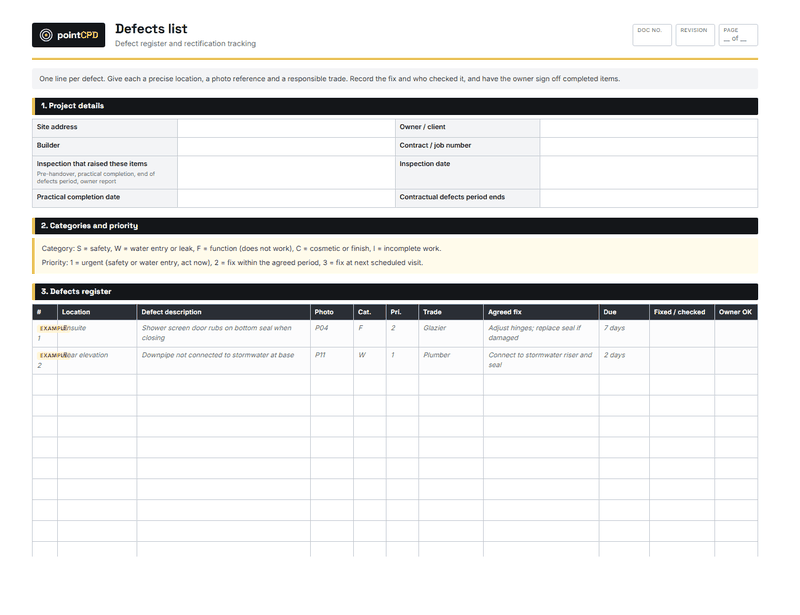
- Build to the documents. Most warranty claims are about work that departed from plans, specifications, standards or manufacturers’ instructions.
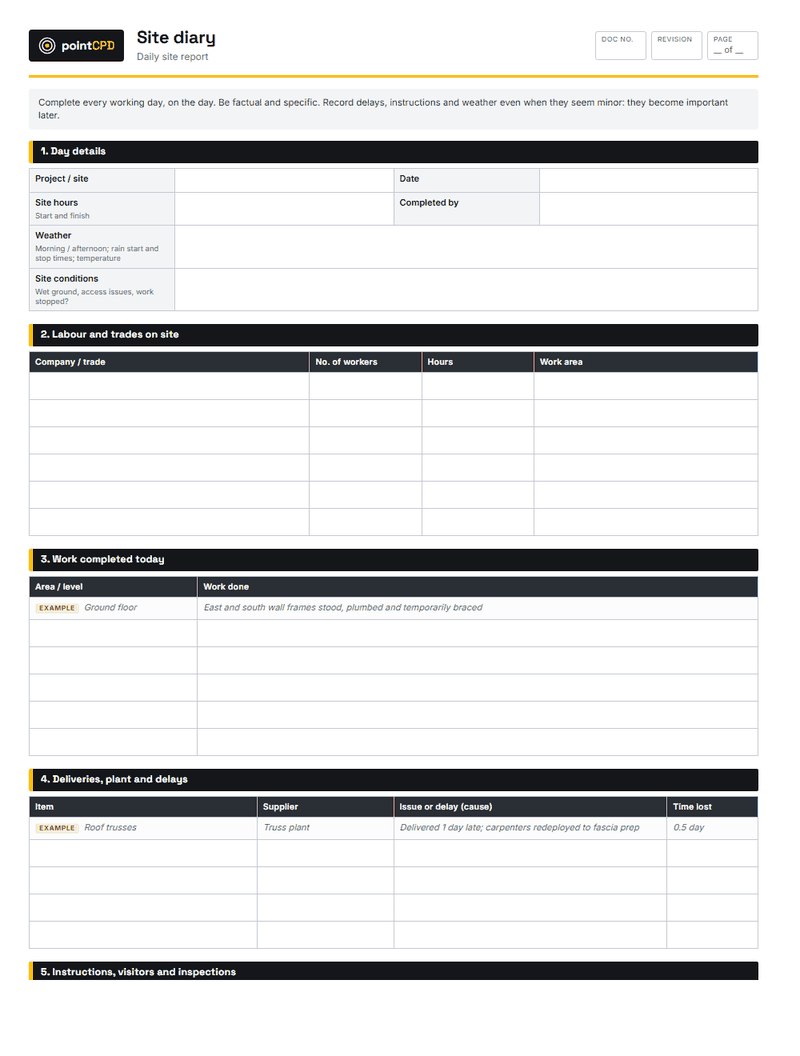
- Document hidden work. Dated photos of footings, reinforcement, waterproofing, framing, insulation and services before covering.
- Collect certificates. Waterproofing, termite, electrical, plumbing, glazing and other compliance certificates.
- Record advice and variations. Especially where the client chose against your advice.
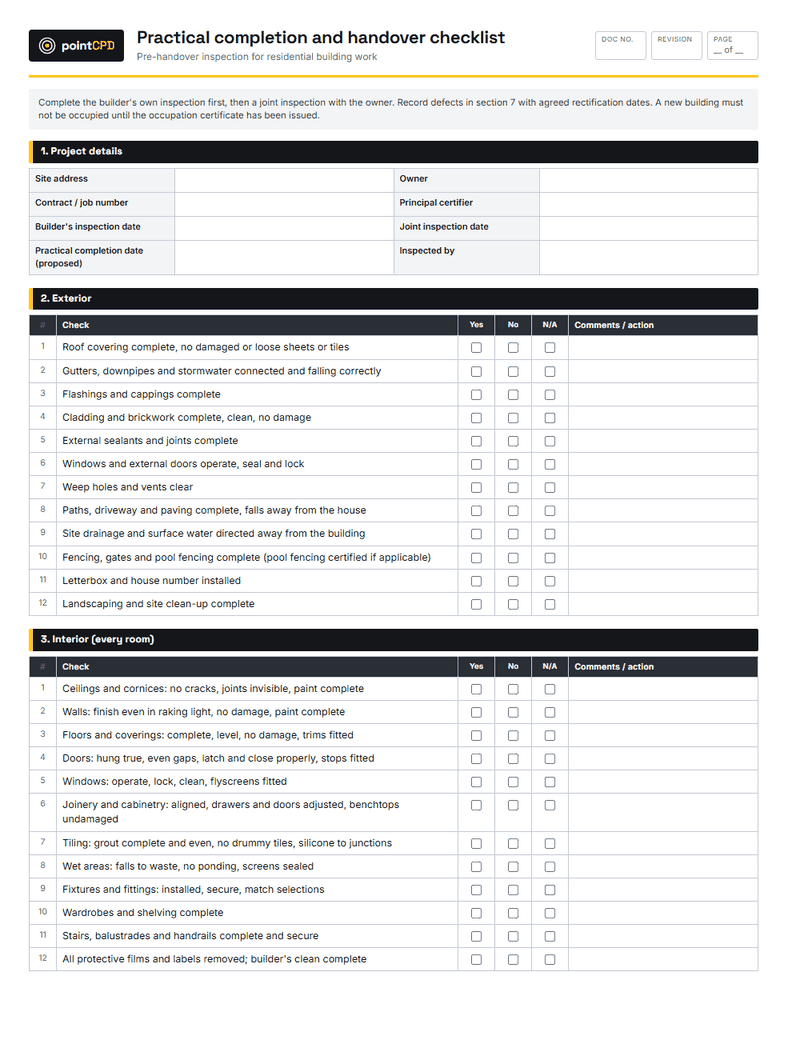
- Hand over well. Maintenance advice, warranties for products, and a clear explanation of what the owner must do.
- Manage subcontractors. Subcontracts that make trades responsible for their own defects for matching periods.
- Keep records for longer than six years. Claims can arrive late, and some extensions apply.
A worked example: the later owner
Five years after completion, a builder receives a letter from a solicitor for the second owner of a house, alleging a major defect: water damage in a lower-floor room from a leaking upstairs bathroom. The original client sold the house two years ago.
The builder’s file contains photos of the upstairs bathroom membrane before tiling, the waterproofer’s certificate, the certifier’s wet area inspection record, and the handover pack with maintenance advice. An inspection finds the membrane intact and the leak coming from a failed flexible hose on a basin mixer installed by the second owner during a renovation. The builder provides the evidence, and the claim is withdrawn. Without the records, the builder would have faced a six-year major defect claim with no way to show what was built.
The bottom line
In NSW, statutory warranties make builders responsible for their work for six years for major defects and two years for other defects, whatever the contract says, and those warranties follow the property to later owners. Build to the documents, record hidden work and advice, collect certificates, hand over properly, pass responsibility down to subcontractors, and respond to claims promptly and professionally. Good records are the builder’s best defence.
Questions builders ask
How long are statutory warranties in NSW?
The NSW Government states that contractors are responsible for work being free of major defects for six years after completion, and for two years for other defects.
What is a major defect under the Home Building Act?
Broadly, a defect in a major element of a building, such as structure, fire safety systems or waterproofing, that causes or is likely to cause the building to be unable to be used, destruction or a threat of collapse. The Act sets out the detail.
Can a contract exclude statutory warranties?
No. The warranties are implied into every residential building contract in NSW and cannot be excluded.
Do statutory warranties pass to new owners?
Yes. Later owners of the property can claim under the statutory warranties within the warranty periods.
Is the defects liability period the same as the warranty?
No. The defects liability period, often 13 weeks for new homes, is a contractual process. The statutory warranties run separately for two or six years.
Sources
- Ensure your new work remains trouble-free (defects and warranties) · NSW Government
- Home Building Act 1989 (NSW) · NSW Legislation
- Resolving building disputes · NSW Government
Published 4 September 2026. General information for builders, not legal, financial or engineering advice for a specific job. Check current requirements with the relevant regulator or standard before relying on them.