Key takeaways
- The Swimming Pools Act 1992 applies to any pool or spa on a residential site that can hold more than 30cm of water, including portable pools.
- A pool fence must be at least 1.2m high, with gaps under the fence and between vertical bars no bigger than 10cm, and a 1.8m barrier where a boundary fence forms part of it.
- A 90cm non-climbable zone must be kept clear around the outside of the fence, plus 30cm inside it.
- Gates must swing away from the pool, self-close from any position and self-latch. Doors and windows can no longer form part of the barrier.
- If a barrier is modified, including during house or yard renovations, the current Act, Regulation and AS 1926.1-2012 apply and earlier exemptions end.
Drowning in swimming pools is a leading cause of preventable death in children under five, and the pool barrier is the main defence. For builders, pool barriers are also one of the building elements most likely to be inspected, most likely to be failed, and most likely to be damaged or compromised by later work, including renovations that have nothing to do with the pool.
With spring here and pool season approaching, this guide sets out what NSW law requires of pool barriers, which Australian Standard applies, what builders need to do on a new pool, and the renovation trap that turns a simple deck or landscaping job into a full pool compliance upgrade. It is based on the NSW Government’s published guidance on pool owner obligations.
Which pools the law covers
The Swimming Pools Act 1992 applies to swimming pools and spa pools on sites with a residential building, a movable dwelling or tourist and visitor accommodation. It covers any excavation, structure or vessel capable of being filled to a depth greater than 30cm and used or designed for swimming, wading, paddling or other aquatic activity. That includes portable and inflatable pools, which must have the same child-resistant barrier as a permanent pool. Pools with a capacity over 2,000 litres may also need development approval.
All pools and spas must be registered on the NSW Swimming Pool Register. Registration is against the property address and does not mean the pool complies; compliance is assessed separately by inspection.
The key measurements
Key pool fence measurements in NSW
Source: NSW Government, pool owner obligations. Check the full requirements in the applicable standard.
The NSW Government summarises the key requirements for pool fencing as follows. A pool fence must be at least 1.2m high, measured from finished ground level. The gap at the bottom must not be bigger than 10cm from finished ground level, and gaps between vertical bars must not exceed 10cm. Where a boundary fence forms part of the pool barrier, it must be 1.8m high. Horizontal climbable bars must be at least 90cm apart. Perforated or mesh barriers must have openings no greater than 13mm for 1.2m fences, and 1.8m mesh barriers with openings greater than 13mm must not exceed 100mm.
Finished ground level is the point that catches builders out. A fence that is 1.2m high when installed can become non-compliant when turf, pavers, mulch or a garden bed raise the ground beside it, or when a retaining wall or step creates a foothold. Measure after landscaping, not before.
The non-climbable zone
The law requires a 90cm non-climbable zone around the outside of the barrier, measured as an arc from the top of the fence towards the ground, so that a child cannot use an object to climb over. Trees, shrubs, barbecues, pot plants, toys, ladders, chairs and similar objects must not be in that zone. It also includes a space extending 30cm inside the pool area, which must be kept clear of footholds and handholds.
For builders, the non-climbable zone affects design and construction as much as the owner’s maintenance. Retaining walls, planter boxes, hose taps, meter boxes, air conditioning units, fence rails on the wrong side and steps in the ground can all create climbable objects. Plan them out of the zone at the design stage.
Check the other side of the fence. A compliant pool fence can fail because of something on the neighbour’s side of a boundary fence, or a new air conditioning unit or garden bed installed after handover. Look at the whole barrier, from both sides.
Gates, doors and windows
Pool gates must swing outwards, away from the pool area; shut automatically from any open position without having to be forced; and self-latch when they close. They must never be propped open. Older pools sometimes used doors or windows from the house as part of the barrier. That is no longer allowed.
Gate hardware is where barriers most often fail in practice. Hinges sag, latches drift out of alignment as posts move, and self-closing mechanisms weaken. Install quality hardware, set the gate so it closes from any position, and test it repeatedly at handover.
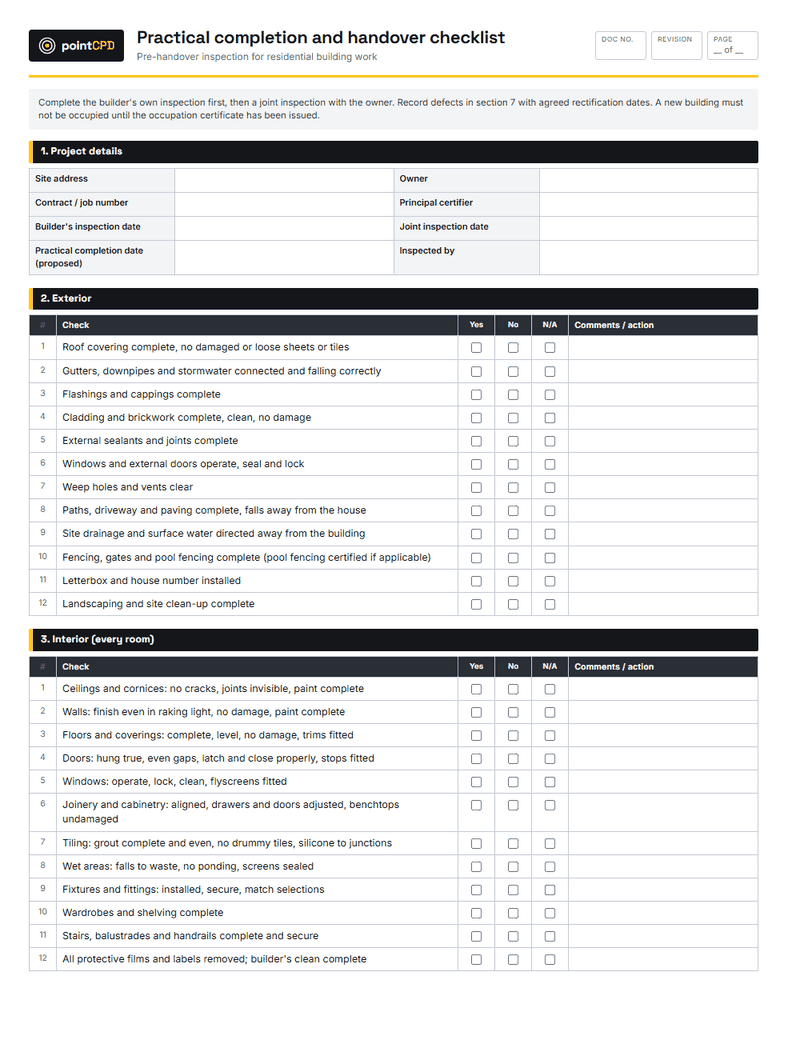
Pool gate and fence checks at handover
- Gate swings outwards, away from the pool area.
- Gate self-closes from any open position without being pushed.
- Gate self-latches every time it closes.
- No gap under the fence or between vertical bars over 10cm.
- Non-climbable zone clear: no plants, pots, barbecues, taps or ledges.
- No doors or windows forming part of the barrier.
- CPR sign installed, in good condition and readable from 3m.
- All bolts, screws and fixings tight.
Which standard applies
Three versions of the pool barrier standard are relevant in NSW, depending on when the pool was built. AS 1926-1986 may apply to pools constructed before 30 August 2008. AS 1926.1-2007 may apply to pools constructed between 1 September 2008 and 30 April 2013. AS 1926.1-2012 applies to pools constructed from 1 May 2013.
Which pool safety standard applies
- Before 30 Aug 2008AS 1926-1986May apply to pools constructed before this date.
- 1 Sep 2008 – 30 Apr 2013AS 1926.1-2007May apply to pools constructed in this period.
- From 1 May 2013AS 1926.1-2012Applies to pools constructed from this date, and to any modified barrier.
- 29 April 2016Sale and leaseProperties with registrable pools need a certificate to be sold or leased.
- 1 Sep 2019New CPR signsRequired for new pools and substantially altered barriers.
Source: NSW Government.
The renovation trap
This is the rule builders most need to know. If a pool barrier is modified or altered, which the NSW Government notes can include house and yard renovations, the current Swimming Pools Act, the Swimming Pools Regulation 2018 and AS 1926.1-2012 apply, and any previous exemptions cease.
In practice, that means a renovation that changes part of the barrier can require the whole barrier to be brought up to the current standard. Common triggers include:
- an extension or alteration where the house wall, a door or a window formed part of the pool barrier;
- a new deck, pergola or outdoor kitchen next to the pool fence;
- replacing a boundary fence that forms part of the barrier;
- landscaping, retaining walls or paving that change ground levels or add climbable objects;
- relocating a gate or changing access to the pool area.
Identify the pool barrier at the quoting stage of any renovation on a property with a pool. Tell the owner, in writing, if the work will affect the barrier and what an upgrade may involve, and include it in the scope and price. Discovering it at the final inspection is expensive for everyone.
Building a new pool
When a new pool is built, the NSW Government says owners must use a builder licensed by Building Commission NSW, ensure a principal certifier is appointed, and install child-resistant temporary fencing around the pool area during construction. The permanent fence must comply with the Building Code of Australia and be inspected by the principal certifier once installed. The pool must not be used until an occupation certificate has been issued, and signage saying so must be installed and maintained.
For builders, the temporary fencing during construction deserves as much care as the permanent barrier. An excavation that fills with rainwater is a drowning hazard, and the builder controls the site. Keep temporary fencing intact and secure at the end of every day.
Sale, lease and inspections
Since 29 April 2016, properties with registrable pools cannot be sold or leased without a valid swimming pool certificate, subject to the options the law allows. Councils run pool barrier inspection programs, investigate complaints and can direct owners to fix non-compliant barriers. Registered swimming pool inspectors can inspect and issue certificates of compliance or non-compliance, and must notify the owner and the council when a pool does not comply. Builders are often called in after a failed inspection, and a clear understanding of which standard applies is essential to scoping the fix.
CPR signs and spas
A cardiopulmonary resuscitation sign must be displayed near the pool, in good condition and readable from 3m away. New CPR signs came into effect on 1 September 2019; all new pools must use them, and existing pools must update when the barrier is substantially altered or rebuilt. Some spa pools can use a securely fastened, child-resistant lid, grille or mesh instead of a fence, depending on their size and function; larger swim spas may need a fence.
A worked example: the new deck
A builder is asked to replace an old timber deck beside a pool built in the 1990s. The existing pool barrier uses the house wall and a sliding door on one side. The builder notices that the new deck will alter the barrier, and that doors can no longer form part of it. Before quoting, the builder explains to the owner that the work will trigger the current requirements, and that a new fence and gate will be needed between the house and the pool. The owner agrees, the fence goes into the scope and price, and the final inspection passes first time.
The bottom line
Pool barriers are a life-safety system. Know the measurements, keep the non-climbable zone clear in the design, install gate hardware that works every time, and measure from the finished ground level. On renovations, check whether your work alters the barrier, because if it does, the whole barrier may need to meet the current standard. Tell the owner early, and put it in the contract.
Questions builders ask
How high does a pool fence need to be in NSW?
At least 1.2m, measured from finished ground level. Where a boundary fence forms part of the pool barrier, it must be 1.8m high.
What is the maximum gap in a pool fence?
No gap under the fence bigger than 10cm from finished ground level, and no more than 10cm between vertical bars.
What is the non-climbable zone for pool fences?
A 90cm zone, measured as an arc from the top of the fence towards the ground on the outside, plus 30cm inside the pool area, which must be kept clear of objects that could be used to climb.
Do renovations mean my pool fence must be upgraded?
If the pool barrier is modified or altered, including through house or yard renovations, the current law and AS 1926.1-2012 apply and previous exemptions cease.
Can a house door or window form part of a pool barrier?
No. Older pools sometimes used doors or windows as part of the barrier, but this is no longer allowed. If the barrier is altered, a compliant fence and gate will be needed.
Which Australian Standard applies to my pool fence?
It depends on when the pool was built: AS 1926-1986 may apply before 30 August 2008, AS 1926.1-2007 from 1 September 2008 to 30 April 2013, and AS 1926.1-2012 from 1 May 2013 and to any modified barrier.
Do portable pools need a fence in NSW?
Yes. Portable pools that can hold more than 30cm of water must have a child-resistant barrier that complies with the Australian Standard, like a permanent pool.
Sources
- Owning a pool or spa: your obligations · NSW Government · 2026-03-16
- Building a pool: your rights and obligations · NSW Government
Published 10 September 2026. General information for builders, not legal, financial or engineering advice for a specific job. Check current requirements with the relevant regulator or standard before relying on them.