Key takeaways
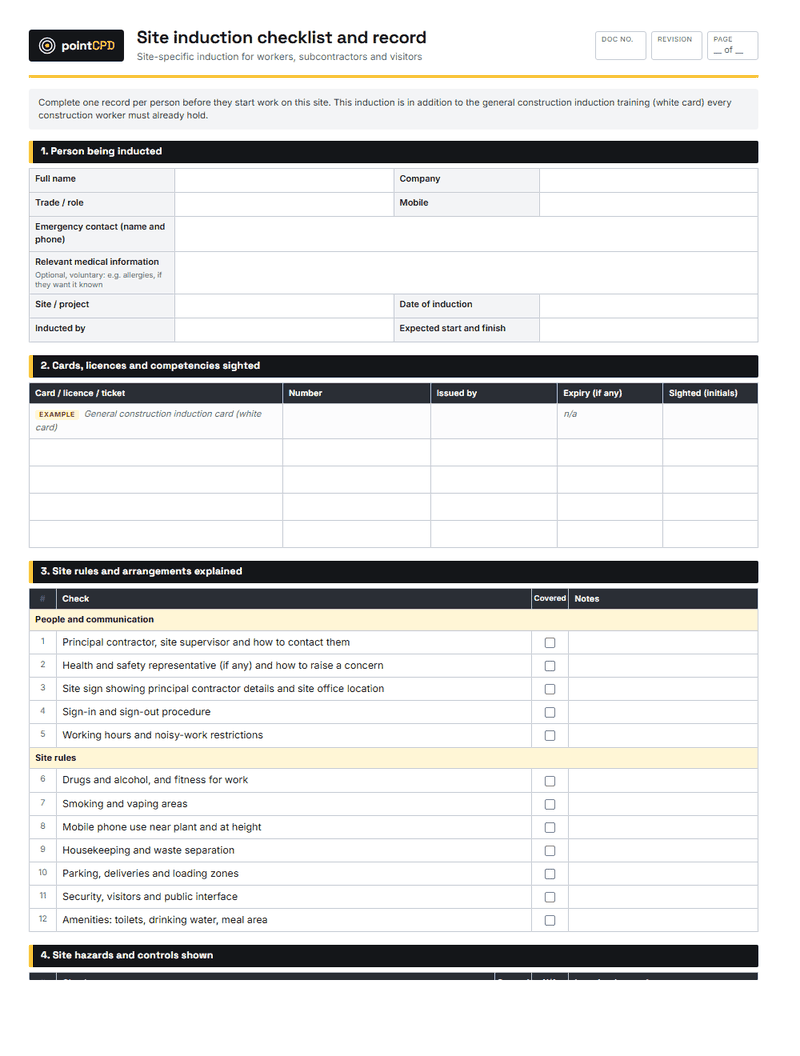
- An induction record is evidence that a person was told about the specific risks on your site, so it needs to name the site, the date, the person and what was covered.
- Site-specific content is the part that matters: the location of the board, the isolation point, the amenities, the emergency assembly point and the no-go zones.
- Visitors, delivery drivers and real estate photographers need a short induction too, because they arrive without any knowledge of the site and often without PPE.
- Records should be kept in a form you can retrieve after the job is finished, because claims and regulator enquiries surface long after the trades have left.
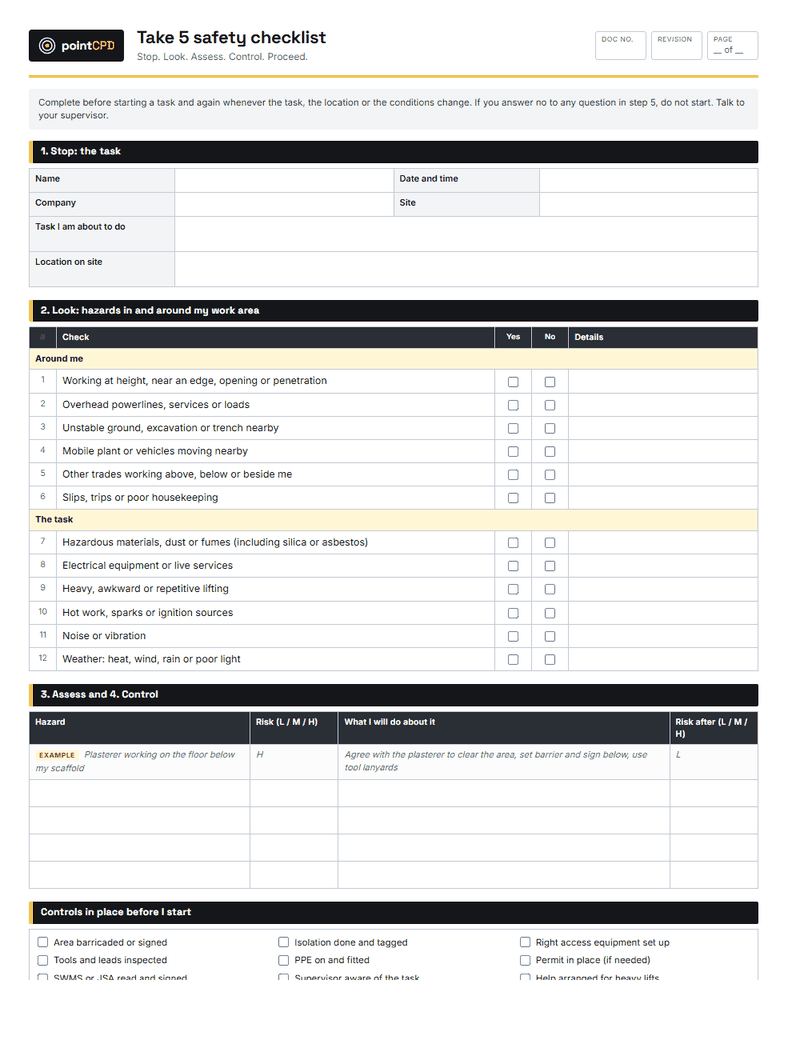
- A signed induction sheet does not replace task-specific controls such as a safe work method statement for high-risk construction work or a documented take 5 before the task starts.
Every house site has a point where a new person walks in and does not know anything about it. They do not know where the board is, which excavation is open, which part of the slab is still curing, where the isolation point is, or who to tell if something goes wrong. An induction is the mechanism that closes that gap, and the record is the mechanism that proves you closed it.
The trap for residential builders is that induction gets treated as a formality. A subbie signs a sheet on the way past, the sheet goes in a folder, and nobody looks at it again until something happens. When something does happen, the sheet is the first document anyone asks for, and a sheet that says “site induction completed” with a signature tells an investigator almost nothing.
This article is about the content and the record, not the logistics of setting up a site. It covers what to put in front of subbies and visitors on a house site, how to capture it so it holds up later, and where the common gaps sit.
Why the record matters more than the induction itself
From a compliance point of view, the induction is a control and the record is the evidence that the control was applied. A principal contractor has a duty to manage risks on the site, and one of the ways that duty is discharged is by making sure people who come onto the site understand the risks and the rules. If you cannot show that you told them, the duty is hard to demonstrate.
The commercial reality is that this surfaces slowly. Nothing happens for months, the job finishes, the trades move on to the next site, and then a workers compensation claim or a regulator enquiry arrives about an incident that happened on your job. At that point the induction record is one of the few documents that speaks to what the person knew before the incident. If it names the site, the date, the person and the topics, it does real work. If it is a generic sign-on sheet that could belong to any job, it does not.
There is a second reason to keep records properly, which is that business records generally need to be retained and be retrievable. The Australian Taxation Office sets out the general expectation that records are kept in a form that allows you to show what happened and when. That is a tax framing, but the same discipline applies to safety records: a document you cannot find is a document you do not have.
Inducting a subbie on a house site
- 1Confirm the paperworkCheck the licence, insurance and any tickets before the person steps onto the site, not after.
- 2Walk the sitePoint out the board, amenities, first aid, isolation point, emergency assembly point and the areas that are out of bounds.
- 3Cover the current risksExplain what is happening on the site this week: excavations, scaffolding, roof work, wet weather access, deliveries.
- 4Explain the rulesState the PPE requirement, the housekeeping expectation, the smoking and hot works rules and who controls the site.
- 5Record and signComplete the induction record on the spot, have the person sign it, and file it the same day.
What actually goes into a house site induction
Commercial site inductions are often long because the site is large and the risks are varied. A house site is smaller, but the risks change fast, which is why the induction has to be specific rather than generic. The content splits into two parts: the things that are true of every site you run, and the things that are true of this site this week.
The standing content
- Who the principal contractor is, who the site supervisor is, and how to contact them.
- Where the site notice board is and what is on it.
- The PPE requirement for the site and when it changes, for example during roof work or demolition.
- The location of amenities, drinking water, first aid and the emergency assembly point.
- The location of the isolation point and the rule about who can energise or de-energise circuits.
- Housekeeping expectations: where waste goes, where materials are stored, how access paths are kept clear.
- Incident and hazard reporting: who to tell, how quickly, and what happens next.
- The rule about not altering scaffolding, edge protection or temporary fencing.
The site-specific content
- What is happening on the site in the period the person will be there: excavation, slab pour, frame, roof, fit-out.
- Which areas are out of bounds and why, for example a freshly poured slab or an unsupported trench.
- Any services that are live or being worked on, and any electrical risks in the area.
- Access and egress arrangements, particularly if the driveway is the only way in and a delivery is due.
- Any asbestos or hazardous material known to be present, and the controls in place.
The site-specific list is what changes week to week, and it is the part most builders skip because it takes effort to write down. It is also the part that most directly addresses the risk the person is about to face.
Electrical risk is the one that catches residential sites out
Safe Work Australia treats electrical safety as a core hazard area, and on a house site the electrical risk is not only the obvious one of working near live wiring. It includes temporary site wiring and leads, tools used in wet conditions, overhead service lines near scaffolding and excavators, and the habit of assuming a circuit is dead because someone said so.
An induction should state the rule plainly: nobody works on or near electrical equipment unless they are competent to do so, the isolation point is known to everyone, and any circuit that has been isolated is tagged and not re-energised by anyone other than the person who isolated it. If a subbie needs to isolate a circuit to do their work, that should be a conversation with the supervisor, not a decision made at the board.
This matters commercially because electrical incidents on residential sites tend to involve people who were not the electrical contractor. A carpenter running a saw off a temporary lead in the rain, or a labourer moving a ladder near an overhead line, is the realistic scenario. Telling them at the induction is cheap. Defending the absence of that instruction later is not.
Inducting visitors, delivery drivers and other short-stay people
Not everyone on site is a subbie. Real estate agents, photographers, valuers, clients, building certifiers, delivery drivers and neighbours who want to talk about the fence all arrive without site knowledge. They have a shorter exposure but often less PPE and less awareness, which makes them the group most likely to walk somewhere they should not.
A short visitor induction is enough for most of them, and it does not need to be a formal sit-down. It needs to cover the assembly point, the out-of-bounds areas, the requirement to stay with an escort, and the PPE they need to be given or to bring. Record it the same way you record a subbie induction, with a name, a time and a signature. If a delivery driver refuses to sign, note that on the record and note who escorted them.
The exception is anyone doing work rather than visiting. A photographer who starts moving materials to get a shot, or a client who picks up a tool, is not a visitor anymore. If someone is going to do any task on the site, they need the working induction, not the visitor one.
What a usable induction record contains
- The site address or a site identifier that matches your job file.
- The date and time the induction was given.
- The full name of the person inducted and their employer or subcontractor.
- The name of the person who delivered the induction.
- The topics covered, listed rather than summarised as "site induction".
- The person’s signature, and a signature from the inducting supervisor.
- Any tickets, licences or competencies sighted and recorded.
What the record should contain, and where builders go wrong
A usable induction record answers four questions: who, when, what, and who delivered it. Everything else is supporting detail. The most common failures on residential sites are a missing site identifier, a missing topic list, and a signature that cannot be matched to a person because the name is illegible or the employer is not recorded.
The site identifier matters more than people expect. If you run several jobs at once, a record that says “induction completed” with no address is useless for showing which site the person was inducted for. Use the address, or a job number that is used consistently across your files, and make sure the number on the induction record matches the number on the job file.
The topic list matters because it shows what the person was actually told. A record that lists the topics covered, even briefly, is far stronger than one that says the induction was completed. If you use a site induction checklist template, the checklist itself becomes the topic list, which is one of the reasons a written checklist is worth the trouble.
Signatures matter, but they are not the whole story. A signature proves attendance, not understanding. If the induction covers something genuinely complex, for example asbestos or high-risk work, a signature on a general induction sheet is not enough on its own.
The mistake that costs the most. Keeping induction records in a folder in the ute or on a phone that gets replaced, so that when a claim or enquiry arrives months later there is nothing to produce. The induction may have been excellent; without a retrievable record it counts for nothing.
Where induction sits alongside other safety documents
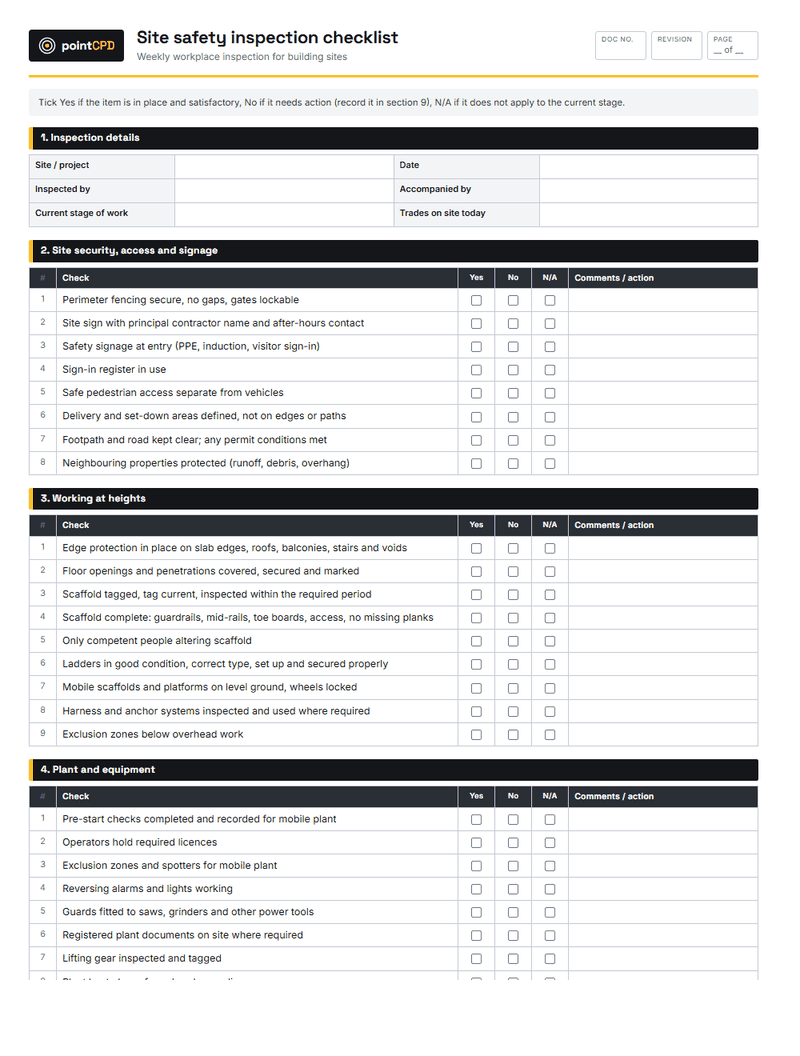
An induction is a site-level control. It does not replace task-level controls, and it does not replace the documents that apply to specific work. On a residential site, the documents that sit alongside the induction are usually the safe work method statement for high-risk construction work, the take 5 or pre-start assessment done before a task, and the inspection records for scaffolding and other plant.
If a subbie is doing high-risk construction work, the induction should include the requirement that they have a safe work method statement for that work, that it is specific to the task, and that it is available on site. Our article on working alone on site covers the detail. The induction record and the safe work method statement are separate documents with separate purposes, and one does not substitute for the other.
Scaffolding is a similar case. The induction tells people not to alter the scaffold. The inspection and handover record is what shows the scaffold was checked and who is responsible for it. If you want the detail on that, the article on scaffold inspection and handover on residential jobs sets out what to capture.
The general principle is that the induction tells people what the rules are, and the task-specific documents show that the rules were applied to the work in front of them. A builder who has the induction record but no task-level documentation has half the picture.
Hazardous materials: what to say and what to check
On older houses, particularly renovations and extensions, the possibility of asbestos is real. The Asbestos and Silica Safety and Eradication Agency publishes guidance for homeowners and trades about asbestos in the home, and the practical message for a site induction is simple: nobody disturbs material they have not identified, and any suspected asbestos stops work until it is assessed.
The induction should tell people who to notify if they find something that looks like asbestos, and it should make clear that the find is not theirs to deal with. If asbestos is known to be present and work is planned around it, that work needs its own controls and its own documentation, and the people doing it need to be trained and equipped for it. A general induction is not the place to manage that risk; it is the place to make sure nobody blunders into it.
Pools are the other site feature worth a specific mention. The NSW Government publishes guidance on pool safety, and on a site where a pool is being installed or an existing pool is present during works, the induction should cover the barrier requirements, the state of any temporary fencing, and the rule that the pool area is out of bounds unless work is being done there. Pools on active sites are a drowning risk and a compliance issue at the same time.
When induction records matter across a job
- Before first attendanceThe subbie is inducted before starting, so the record predates any incident on the site.
- During the buildNew trades, deliveries and visitors are added as the site changes and new risks appear.
- After a near missThe record shows what the person was told, which is the first thing an investigator asks for.
- At practical completionRecords are bundled into the job file rather than left in a folder in the ute.
- Years laterA claim or enquiry arrives and the file is the only thing that answers it.
Worked example: a builder in western Sydney
A builder in western Sydney is running a knockdown-rebuild and a renovation at the same time, with the same supervisor splitting time across both. The supervisor inducts subbies verbally on the first morning, gets them to sign a single sheet that covers both jobs, and keeps the sheet in the site shed at the rebuild.
Six weeks later a subbie twists an ankle on the renovation job. The claim comes in, and the induction sheet that gets produced is the one from the rebuild. It has no address, no job number, and a list of names without employers. The subbie’s name is on it, but so are the names of people who have never been to the renovation site. The builder cannot show that this person was inducted for the site where the incident happened.
The fix is not complicated. Separate induction records per site, each with the address or job number, the date, the person’s name and employer, the topics covered, and the name of the person who delivered it. A copy scanned to the job file the same day, and a paper copy in the site folder. The supervisor spends an extra few minutes per induction, and the records stand up when they are needed.
The wider point is that the record needs to survive the job. If the shed gets cleared at practical completion and the sheets go in a box that nobody can find, the same problem reappears a year later. Scan and file, or use a digital induction form that writes to the job file automatically.
Keeping the records retrievable after the job finishes
The retrieval problem is the one that catches most residential builders, because the gap between doing the right thing and being able to prove it is often just filing. A simple system works: one induction record per person per site, saved to the job folder, named so it can be found by person or by date, and retained for as long as the job file is retained.
If you use a paper system, scan the sheets at the end of each week rather than at the end of the job. If you use a digital form, make sure it captures the same fields and that the data is exportable, because a form that lives inside one app and cannot be exported is a liability if the app changes or the subscription lapses.
It is also worth keeping a simple register that lists who was inducted, when, and by whom, so you can answer the “who was on site that day” question without going through every sheet. That register is also useful for the site diary and for confirming that a new subbie has actually been inducted before they start.
For builders who want the wider picture on how safety and compliance content fits into the CPD cycle, the guide to how NSW builder CPD works explains the structure, and the course catalogue lists the modules that cover site safety topics in more depth.
Induction as a habit, not an event
The failure mode on residential sites is treating induction as a one-off event at the start of the job. On a house site, the workforce changes constantly. New trades arrive at each stage, deliveries happen throughout, and the risks change with the stage of construction. An induction that was accurate at frame stage is not accurate at lock-up.
The practical approach is to induct each person before their first attendance, and to give a short update when the site conditions change materially: a new excavation, a new scaffold, a new crane or pump on site, or a change in access. Record the update the same way you record the initial induction, even if it is a few lines in the site diary with names and a signature.
None of this is elaborate. It is a checklist, a pen, and a habit of filing the record the same day. The builders who get caught out are rarely the ones who skipped the induction; they are the ones who did it and cannot prove it.
Questions builders ask
What has to be on a site induction record?
At minimum, the site address or job identifier, the date, the person’s full name and employer, the topics covered, the name of the person who delivered the induction, and a signature from the person inducted. A record without a site identifier or a topic list is weak evidence because it does not show what the person was told or where.
Do visitors and delivery drivers need to be inducted?
They need a short induction covering the assembly point, out-of-bounds areas, escort requirements and PPE, because they arrive without site knowledge and often without their own PPE. Record it the same way you record a subbie induction, with a name, a time and a signature. Anyone doing actual work on the site needs the full working induction instead.
How long should induction records be kept?
Keep them for as long as you keep the job file, because claims and regulator enquiries can arrive long after practical completion. The general expectation for business records is that they are kept in a retrievable form, and safety records follow the same logic. A record you cannot find when it is requested is effectively a record you do not have.
Does a signed induction sheet cover high-risk construction work?
No. A general induction tells people the site rules and the site-specific risks, but high-risk construction work needs its own safe work method statement that is specific to the task. The induction should state that requirement, but it does not replace the task-level document. Keep both, and keep them separate.
What should the induction say about asbestos on an older house?
It should make clear that nobody disturbs material they have not identified, and that any suspected asbestos stops work until it is assessed. Tell people who to notify and make it clear the find is not theirs to handle. If asbestos is known to be present, that work needs its own controls and trained, equipped people.
Can I induct subbies verbally and record it afterwards?
You can, but record it the same day and capture the same fields as a written induction. A verbal induction with a same-day record that names the site, the date, the person and the topics is far stronger than a memory. If the record is written up weeks later, or not at all, it will not help you when it matters.
Sources
- Record keeping for business · Australian Taxation Office
- Electrical safety · Safe Work Australia
- Pools and pool safety · NSW Government
- Asbestos in the home · Asbestos and Silica Safety and Eradication Agency
Published 24 July 2026. General information for builders, not legal, financial or engineering advice for a specific job. Check current requirements with the relevant regulator or standard before relying on them.