Key takeaways
- Verification is a principal contractor duty, not a paperwork preference, because the person conducting the business or undertaking must ensure the site and the people on it do not create risk to others.
- Proof of insurance and WHS documentation should be collected and checked before the subbie mobilises, not after, because a lapse that surfaces mid-job leaves the principal contractor carrying the exposure.
- The documents that matter most are current public liability and workers compensation cover, a SWMS for high-risk construction work, and evidence of induction and licences for the trades that require them.
- A verification register is what stops a check being remembered on one job and forgotten on the next, because it gives every subcontractor the same gate before mobilisation.
- When a subbie cannot produce a document, the correct response is to hold the start date, not to accept a promise that it will be sent through, because the risk on site is already live.
Every subcontractor who walks onto a residential site brings two things with them: a set of skills you are paying for, and a set of risks you are now responsible for managing. The skills are obvious. The risks are not, because they arrive as documents, and documents are easy to file without reading.
The check you do before a subbie mobilises is the cheapest compliance work you will ever do. On your desk, a missing certificate of currency is a phone call and a delayed start. On site, three weeks later, it is an incident, an insurer asking why an uninsured trade was working under your principal contractor arrangements, and a conversation with a regulator that you would rather not have.
This article is about the verification step itself: what to collect, in what order, and what to do when something is missing. It is not about contract terms, payment protection, or the commercial negotiation with the subbie. It is the gate that sits between awarding the work and letting the trade start.
Why the verification step sits with the principal contractor
On a residential project, the builder is usually the principal contractor. That role carries duties under work health and safety law that cannot be delegated by writing a clause into a subcontract. The person conducting the business or undertaking must ensure the site, the plant, and the people on it do not create risks to themselves or to others.
That is why verification is not a favour to the subbie and not an administrative nicety. It is the mechanism by which you satisfy yourself that the people you are bringing onto the site are competent, covered, and working to a method you have seen. If you skip it, you have not transferred the risk. You have absorbed it.
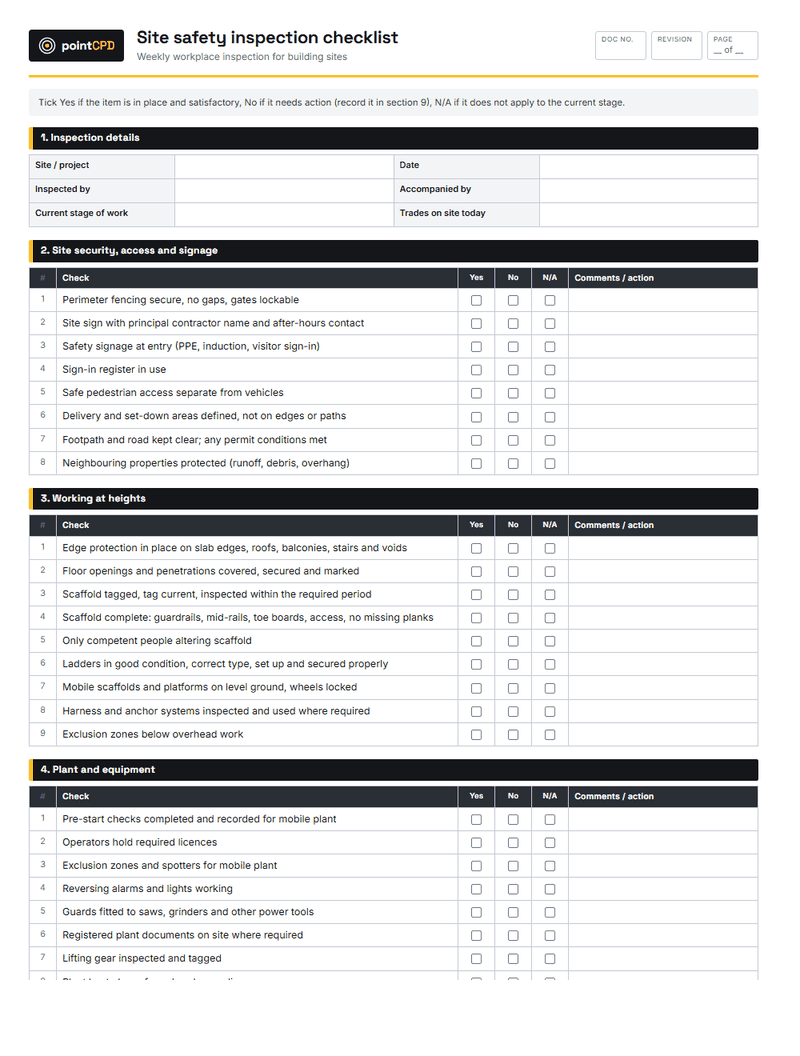
The same logic applies to the site rules themselves. Your ladder safety on site do not stop at the gate; they extend to everyone the subbie brings with them, including labour hire and casuals who may never appear on the original paperwork.
The documents that actually matter before mobilisation
The list is shorter than most builders assume, but every item on it is load-bearing. Start with insurance. A current public liability certificate of currency tells you the subbie can meet a claim if they damage something or injure someone. It does not tell you the cover is adequate for the work, so read the schedule: the limit, the period, and the activities covered all need to match what they are about to do.
Workers compensation is the second piece, and it is the one most often fudged. A subbie who employs anyone needs a policy. A genuine sole trader may be able to rely on an exemption, but you need to see the exemption, not take a verbal assurance. If a worker is injured on your site and there is no cover, the conversation moves quickly to who should have checked.
Then come the trade-specific items. Electrical and other licensed trades need current licensing or registration for the work. High-risk construction work needs a Safe Work Method Statement (SWMS) that describes the actual method for the actual task, not a generic template downloaded and renamed. Plant and equipment brought on site needs inspection records. And every individual who will attend needs a site induction record.
What to have on file before the subbie starts
- Current public liability certificate of currency naming the work and the site.
- Current workers compensation policy, or a valid exemption where the subbie is a genuine sole trader.
- Trade licence or registration where the work requires one.
- SWMS for any high-risk construction work in the scope.
- Site induction record for the individuals who will actually attend.
- Plant and equipment inspection records for anything they are bringing on site.
- Emergency contact and first aid arrangements for their crew.
Reading a certificate of currency properly
Filing a certificate is not the same as checking one. Three things go wrong repeatedly. The first is an expired certificate: the subbie sent you the one from last year because it was the one already in their email. The second is cover that does not extend to the work: a policy written for domestic maintenance when the subbie is about to do structural work. The third is a policy that names a different entity from the one you contracted, which matters if you ever need to make a claim.
The practical fix is to check the dates against the programme, not against today. If the subbie is on site for six weeks, the cover needs to run for at least that long, and you need a note in your register to re-check before it lapses. A subbie whose policy expires mid-job is an uninsured subbie, even if they were covered on day one.
For workers compensation, the same care applies. Confirm the policy is current, that it covers the state you are working in, and that the entity on the policy is the entity doing the work. Where a sole trader claims an exemption, keep a copy of the exemption on file and revisit it if their circumstances change, because sole traders who take on help stop being exempt.
SWMS, inductions and the things builders forget
A SWMS is required for high-risk construction work, and the definition is broader than most builders expect. It covers work at height above a stated threshold, work near live electrical services, demolition, and a range of other activities common on residential sites. The document has to set out the steps, the hazards, the controls, and what happens if the method changes.
What builders forget is that the SWMS is a live document. It has to be reviewed when the method changes, when the site conditions change, or when a new hazard emerges. A SWMS written for a straightforward roof replacement is not adequate once the subbie discovers asbestos or a structural surprise. Verification at mobilisation is the start of the process, not the end of it. Our article on SWMS templates for residential builders in NSW goes through what a usable document looks like.
The other forgotten item is induction. A subbie’s paperwork can be perfect while the individual who turns up on the day has never been inducted onto the site. Induction is what makes the site rules, the emergency arrangements, and the location of services real for the person doing the work. If your induction process is thin, the site induction checklist for residential projects is a useful starting point.
A pre-mobilisation verification checklist you can run on every job
The value of a checklist is that it removes judgement from the routine parts of the job, so your judgement is available for the parts that are genuinely unusual. The following sequence works on a residential project of any size.
First, confirm the scope and dates in writing. You cannot verify insurance or method against a scope that is still moving. Second, send the subbie the document list at the same time as the subcontract, so there is no surprise about what is required. Third, check the documents when they arrive, not the day before the start.
Fourth, resolve gaps by holding the start date. This is the step builders skip, usually because the programme is tight and the subbie is reliable and it feels unreasonable to delay them over a certificate. But the delay is a programme problem; an uninsured injury is a different order of problem entirely. Fifth, induct the individuals who will actually attend, and record it. Sixth, log the expiry dates in a register and diarise the re-checks.
The pre-mobilisation sequence
- Award and scopeConfirm the trade, the scope, the site, and the dates in writing before you ask for compliance documents.
- Request documentsSend the subcontractor the same list every time: insurance, licences, SWMS, induction records.
- Check the documentsRead the certificates, not just the file names, and confirm the cover matches the work and the dates.
- Resolve gapsWhere something is missing or expired, hold the start date and tell the subbie what is required.
- Induct and mobiliseOnly after the file is complete does the subbie go through site induction and start work.
- Maintain the registerTrack expiry dates and re-verify before the next stage or the next job.
What goes wrong when verification is left to the day of mobilisation
The failure mode is predictable. The subbie arrives, the crew is ready, the programme is tight, and the documents are somewhere in a ute. Someone says they will send them through tonight. Work starts. The documents never arrive, or they arrive with a gap, and by then the subbie is embedded in the programme and the cost of stopping them has grown.
The commercial reality is that the cost lands on the builder. If an uninsured worker is injured, the principal contractor’s own public liability insurer may be drawn in, premiums move at renewal, and the builder carries the disruption. If a regulator inspects the site and the verification records are incomplete, the builder is answering the questions, not the subbie. And if the subbie’s insurer declines cover because the policy did not match the work, the builder discovers the gap at the worst possible moment.
There is also a quieter cost. Builders who verify consistently tend to attract subcontractors who also verify consistently. Builders who do not tend to attract the ones who cannot get on other sites. The verification gate is, in practice, a filter on who you work with.
Worked example: a western Sydney builder and a tiling package
A builder in western Sydney was running a first-floor addition and had engaged a tiling subcontractor for the wet areas. The subbie was known to the builder, had worked on two previous jobs, and had never had an incident. The programme had the tiler starting on a Monday.
On the Friday, the builder ran the pre-mobilisation check for the first time as a formal step rather than a memory exercise. The public liability certificate on file was current. The workers compensation policy was not: the subbie had changed from a sole trader to a company and the policy had been rewritten under the new entity, with a lapse between the two. The subbie had not noticed, because the invoices still looked the same.
The builder held the Monday start. The subbie spent the weekend with their broker, the policy was reinstated under the correct entity, and the tiler started on the Wednesday. Two days of programme slipped. If the same gap had been discovered after an injury, the exposure would have been the builder’s, and the conversation with the insurer would have been about why an uninsured entity was working under the builder’s principal contractor arrangements.
Nothing about this example is unusual. The change of entity, the unnoticed lapse, and the reliance on a working relationship instead of a document check are all common. What made the difference was that the check happened before mobilisation, when the fix was cheap.
Principal contractor and subcontractor responsibilities
| Principal contractor | Subcontractor |
|---|---|
| Sets the site rules and the verification gate | Provides current insurance and licence evidence |
| Confirms the subbie’s documents are complete before mobilisation | Prepares a SWMS for high-risk work in their scope |
| Inducts the subbie’s workers onto the site | Ensures their workers attend induction |
| Monitors the site for changing risk | Manages the risk in their own work method |
| Keeps the verification register current | Notifies of any change to cover, licence or method |
Keeping the register current across the job
Verification is not a one-off. Policies expire, licences renew, entities change, and crews turn over. A register that records each subcontractor, the documents held, the expiry dates, and the date of the last check is the difference between a system and a habit. The register does not need to be complicated; a spreadsheet with a review date column will do.
Builders who run several jobs at once should also think about portability. A subcontractor verified for one site is not automatically verified for the next, because the cover may be site-specific and the induction certainly is. Re-verify at the point of mobilisation on each job, even if the subbie worked for you last month.
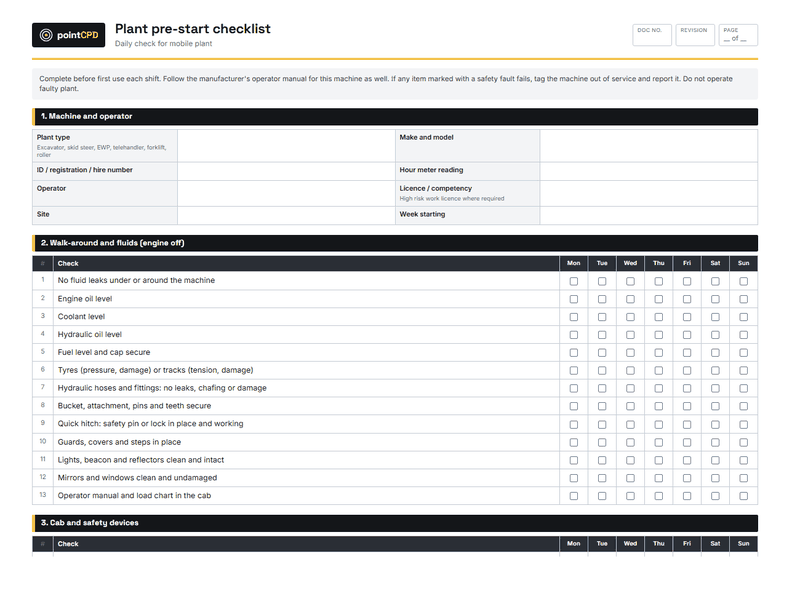
Where you are bringing plant onto site, the pre-start checks are a separate routine. The plant pre-start checklist template covers the daily inspection side of that, which sits alongside the document verification rather than replacing it.
Where this fits in your own competence and CPD
Verification is one of those areas where the law, the insurance market, and the trades themselves keep moving. Coverage wordings change, licensing requirements change, and the definition of high-risk construction work is applied differently as the regulator’s guidance develops. A builder who learned the rules a decade ago and has not revisited them is working from an outdated map.
That is the reason supervision and compliance sit inside the continuing professional development requirements for licensed builders in NSW. The guide to how NSW builder CPD works sets out the categories and the record-keeping, and the PointCPD course catalogue has options that cover site supervision and safety. If you want to see how the courses are structured before you commit, the PointCPD home page for NSW builder CPD is the place to start.
None of this replaces the practical step. The practical step is the gate: documents checked, dates confirmed, gaps resolved, induction done, register updated. Run it before every mobilisation, and the rest of the job gets easier.
The mistake that costs the most. Letting a subbie start because the documents are “coming through” transfers their risk onto your site and your insurance. Hold the start date until the file is complete; a short programme delay is recoverable, an uninsured injury is not.
Frequently asked questions
What documents should I collect from a subcontractor before they start on a residential site?
At minimum, a current public liability certificate of currency, current workers compensation cover or a valid exemption, any trade licence or registration the work requires, a SWMS for high-risk construction work in their scope, plant inspection records, and induction records for the individuals who will attend. The exact list depends on the trade and the work, so check the current requirement for the specific activity.
Is a certificate of currency enough to prove a subcontractor is insured?
No. A certificate shows cover exists at a point in time, but it does not confirm the limit is adequate, that the activities match the work, or that the entity on the policy is the entity you contracted. Read the schedule, check the dates against your programme, and diarise a re-check before the policy expires.
Can a sole trader subcontractor work without workers compensation cover?
Some sole traders can rely on an exemption, but you need to see the exemption document rather than accept a verbal assurance. The position changes if the sole trader takes on help, because they stop being a sole trader for that purpose. Confirm the current requirement with the relevant regulator before you accept the exemption.
When does a subcontractor need to provide a SWMS?
A SWMS is required for high-risk construction work, which includes work at height above a stated threshold, work near live electrical services, demolition, and other activities common on residential sites. The document must describe the actual method for the actual task, and it must be reviewed when the method or site conditions change.
What do I do if a subcontractor’s insurance expires mid-job?
Treat it as a live risk and stop the work until cover is reinstated. A subbie who was covered on day one but is uninsured on day thirty is an uninsured subbie for the days that matter. Record the lapse, confirm the reinstated policy, and re-check the dates against the remaining programme.
Does verifying a subcontractor once cover them for future jobs?
No. Policies expire, entities change, licences renew, and site inductions are site-specific, so the check has to be repeated at each mobilisation. A register that tracks expiry dates and review dates makes the repeat check routine rather than something you have to remember.
Questions builders ask
What documents should I collect from a subcontractor before they start on a residential site?
At minimum, a current public liability certificate of currency, current workers compensation cover or a valid exemption, any trade licence or registration the work requires, a SWMS for high-risk construction work in their scope, plant inspection records, and induction records for the individuals who will attend. The exact list depends on the trade and the work, so check the current requirement for the specific activity.
Is a certificate of currency enough to prove a subcontractor is insured?
No. A certificate shows cover exists at a point in time, but it does not confirm the limit is adequate, that the activities match the work, or that the entity on the policy is the entity you contracted. Read the schedule, check the dates against your programme, and diarise a re-check before the policy expires.
Can a sole trader subcontractor work without workers compensation cover?
Some sole traders can rely on an exemption, but you need to see the exemption document rather than accept a verbal assurance. The position changes if the sole trader takes on help, because they stop being a sole trader for that purpose. Confirm the current requirement with the relevant regulator before you accept the exemption.
When does a subcontractor need to provide a SWMS?
A SWMS is required for high-risk construction work, which includes work at height above a stated threshold, work near live electrical services, demolition, and other activities common on residential sites. The document must describe the actual method for the actual task, and it must be reviewed when the method or site conditions change.
What do I do if a subcontractor’s insurance expires mid-job?
Treat it as a live risk and stop the work until cover is reinstated. A subbie who was covered on day one but is uninsured on day thirty is an uninsured subbie for the days that matter. Record the lapse, confirm the reinstated policy, and re-check the dates against the remaining programme.
Does verifying a subcontractor once cover them for future jobs?
No. Policies expire, entities change, licences renew, and site inductions are site-specific, so the check has to be repeated at each mobilisation. A register that tracks expiry dates and review dates makes the repeat check routine rather than something you have to remember.
Sources
- Rising fuel costs: what trades need to know about contracts, insurance and compliance · Building Commission NSW · 2026-04-28
- Unfair contract terms · Australian Competition and Consumer Commission
- Contracts for home building work · NSW Government · 2026-04-29
- Electrical safety · Safe Work Australia
Published 2 August 2026. General information for builders, not legal, financial or engineering advice for a specific job. Check current requirements with the relevant regulator or standard before relying on them.