Key takeaways
- A substitute product must meet the same performance requirements as the one specified, for the way it will be used. “Equivalent” is a claim to be proved, not assumed.
- Non-conforming products are bad products. Non-complying products are good products used in the wrong place. Both are the builder’s problem once installed.
- Ask for evidence of suitability, such as a CodeMark certificate, test reports from an accredited laboratory or a product technical statement, and check it covers your use.
- A substitution is usually also a contract variation, may change BASIX commitments, and on Class 2 buildings may need a varied regulated design before the work is done.
- Record every substitution: what changed, why, who approved it and the evidence relied on. That record is your defence in a defect claim years later.
Product substitution is part of every builder’s week. The specified window is on a twelve-week lead time; the supplier has a similar one in stock. The membrane the waterproofer prefers is not the one on the drawings. The cladding went up in price and there is a cheaper board that looks the same. Most of these swaps are sensible and cause no problems. But the ones that go wrong become some of the most expensive defects in residential building, because they are built into the structure, the envelope or the fire safety of the home.
This guide sets out what builders need to check before substituting a specified product, why “equivalent” is not enough, and how to document a substitution so it stands up if it is questioned years later.
Why substitution is a risk
A specified product was chosen, at least in theory, because it meets the performance requirements for its use: structural capacity, fire resistance, weatherproofing, thermal performance, durability. When a builder swaps it, the builder takes on the job of making sure the new product meets those same requirements, in the same application, as part of the same system. If it does not, the builder usually carries the consequences: rectification, a failed inspection, a delayed occupation certificate, or a defect claim under the statutory warranties.
The risk is often invisible at the time. A substitute membrane may look and feel the same but be incompatible with the primer or the tile adhesive. A cheaper plasterboard may carry the same thickness but not the same fire rating in the tested wall system. A different window may have a similar frame but a very different energy performance, changing the home’s BASIX outcome.
Non-conforming and non-complying
The NSW Government draws a useful distinction. Non-conforming products are, in simple terms, bad products: they claim to be something they are not, do not meet the standards required for their intended use, or are marketed to deceive. Non-complying products are products used badly: they may be perfectly good products, but they are used where they do not meet the requirements of the NCC, other laws or Australian Standards.
Non-conforming or non-complying?
| Non-conforming | Non-complying |
|---|---|
| A bad product | A good product used badly |
| Claims to be something it is not, or does not meet the standard it claims | Used where the NCC, a standard or the law requires something else |
| Example: a panel labelled non-combustible that is combustible | Example: a genuinely combustible panel used where non-combustible is required |
| Risk sits with the supply chain, and then the builder who installed it | Risk sits with whoever selected and installed it for that use |
Source: Based on the NSW Government’s guidance on non-conforming building products.
For builders, the distinction matters because the defence is different. Against non-conforming products, the protection is buying from reputable suppliers and asking for genuine evidence of conformity. Against non-complying use, the protection is checking that the product is suitable for this specific application, which is the builder’s and designer’s job, not the supplier’s. The NSW guidance is blunt about where the risk lands: much of it falls to the builders and trades who install the products, because they do the work and are the ones most likely to have to fix it.
Evidence of suitability
The NCC requires that materials and products used to meet its requirements are fit for their intended purpose, and it sets out the kinds of evidence that can be used to show suitability. These include a CodeMark certificate of conformity, a report from an accredited testing laboratory, a certificate or report from an appropriately qualified professional, and a product technical statement, among other forms of documentary evidence. The ABCB’s evidence of suitability handbook explains how the provisions work.
The key question is not whether evidence exists, but whether it covers your use. A test report for a wall system in one configuration does not cover a different stud spacing, a different board or a different sealant. A product technical statement that limits use to certain wind classifications or climate zones does not cover a site outside them. Read the limitations, not just the headline.
Systems are tested as systems. Fire-rated walls, waterproofing systems and cladding assemblies are tested and certified as combinations of specific products. Swapping one component, even for a good product, can mean the system as built is no longer the system that was tested.
Five checks before any product substitution
- 1PerformanceDoes the substitute meet the same NCC and standard requirements, for this use, in this location?
- 2EvidenceIs there evidence of suitability that actually covers this application and system?
- 3Design and approvalsDoes it change the approved plans, BASIX commitments, a fire engineer’s report or a regulated design?
- 4ContractDoes the contract allow it? Put it in writing as a variation, signed before the work is done.
- 5SystemIs it compatible with the products around it, and does it void any system warranty?
Substitution is usually a variation
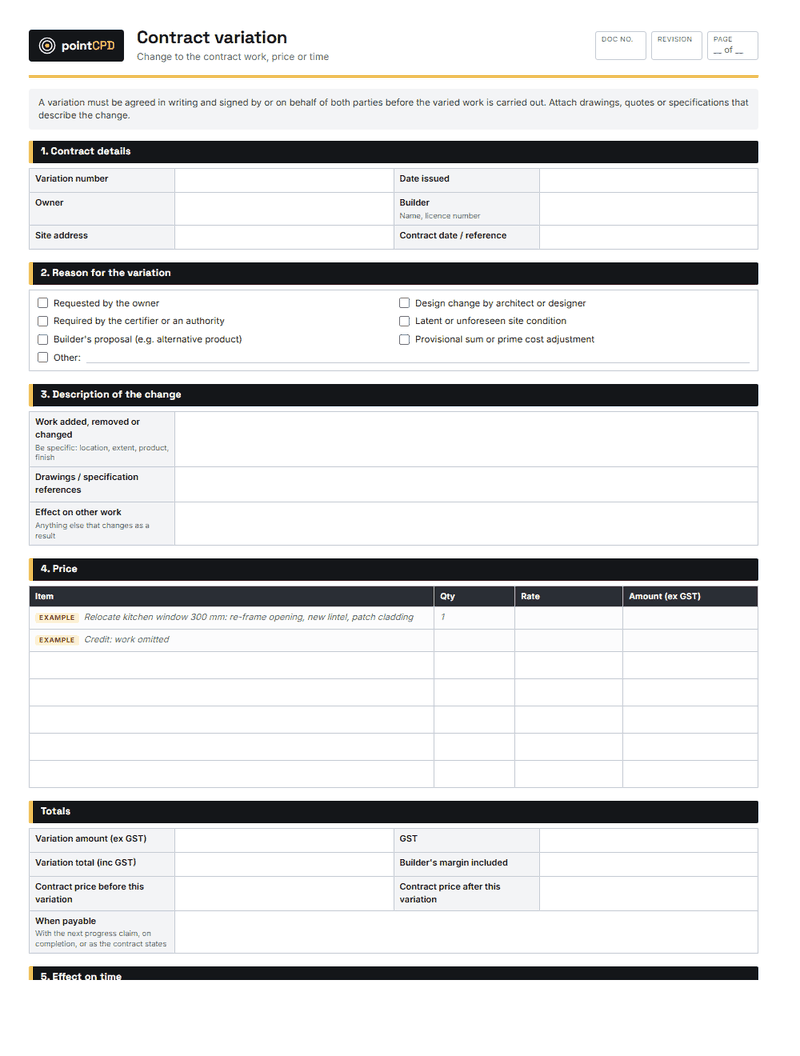
If the product is named in the contract, the plans or the specification, changing it is changing the contract. Under the Home Building Act in NSW, agreements to vary a residential building contract, or the plans and specifications, need to be in writing and signed by or on behalf of each party. A substitution agreed on the phone, or simply made on site, leaves the builder exposed if the owner later says they never agreed to it, or if the substitute performs differently.
Even where the contract allows the builder to substitute products of equal or better quality, the builder should still tell the owner in writing, explain why, and keep the evidence that the substitute meets the specification. See our guide to writing a building variation in NSW for the practical detail.
Approvals, BASIX and certification
Some substitutions change what was approved. A different window, glazing type, insulation product or hot water system can change the commitments on the home’s BASIX certificate, and a builder cannot simply swap them without checking whether the certificate still holds. If the change affects the commitments, a revised certificate may be needed, and the certifier will want to see that the home as built matches the certificate at the final inspection.
Substitutions can also affect the development consent or complying development certificate, a fire engineer’s performance solution, a structural engineer’s design or a bushfire assessment. The certifier is the right person to ask before the work is done, not after. Certifiers inspect critical stages and look for evidence of suitability; a substitution they discover at the final inspection, without documentation, is a common cause of delays to the occupation certificate.
Class 2 buildings and regulated designs
On apartment buildings and other buildings covered by the Design and Building Practitioners Act, the stakes are higher. Building elements such as waterproofing, fire safety systems, the structure and the building enclosure are designed and declared by registered design practitioners. A substitution that changes a regulated design is not just a variation with the client. It may need a varied design and a new design compliance declaration before the work proceeds, and the builder’s own compliance declaration depends on the building matching the declared designs.
Substitutions that need extra care
- Waterproofing membranes and their primers, bond breakers and flashings.
- Fire-rated systems: plasterboard, sealants, collars and penetration seals are tested as systems.
- External cladding and its fixings, cavity battens and sarking.
- Windows and glazing, which carry BASIX and energy-rating values.
- Insulation, where the R-value and installation method were assessed.
- Structural connectors, fixings, bracing and tie-down products.
- Plumbing products that need WaterMark certification.
- Safety glass and balustrade systems.
The like-for-like trap
“Like for like” is the phrase that causes the most trouble. A product that looks the same, has the same dimensions and does the same job is not necessarily equivalent. It may not carry the same certification, it may not have been tested in the same system, and it may not be approved for the same environment. Electrical, plumbing and gas products add another layer, because some of them need specific certification before they can be sold or installed at all. Treat “like for like” as a question to be answered with evidence, not an answer.
A worked example: the membrane swap
A builder’s waterproofer arrives on site with a different liquid membrane from the one specified, because the specified product is out of stock and the job is on a deadline. The builder asks three questions before any work starts. Does the substitute have evidence of suitability for internal wet areas, to the relevant standard, in this substrate? Is it compatible with the primer, the bond breaker and the tile adhesive in the system? And does the contract require the owner’s agreement?
The waterproofer produces the manufacturer’s technical data sheet and its certification, which cover the application. The tile adhesive manufacturer confirms compatibility. The builder sends the owner a short written variation explaining the change at no extra cost, which the owner signs that afternoon. The waterproofer’s installation is photographed at each stage, and the certification and variation go into the job file. If a leak is ever alleged, the builder can show exactly what was used and why.
Documenting a substitution
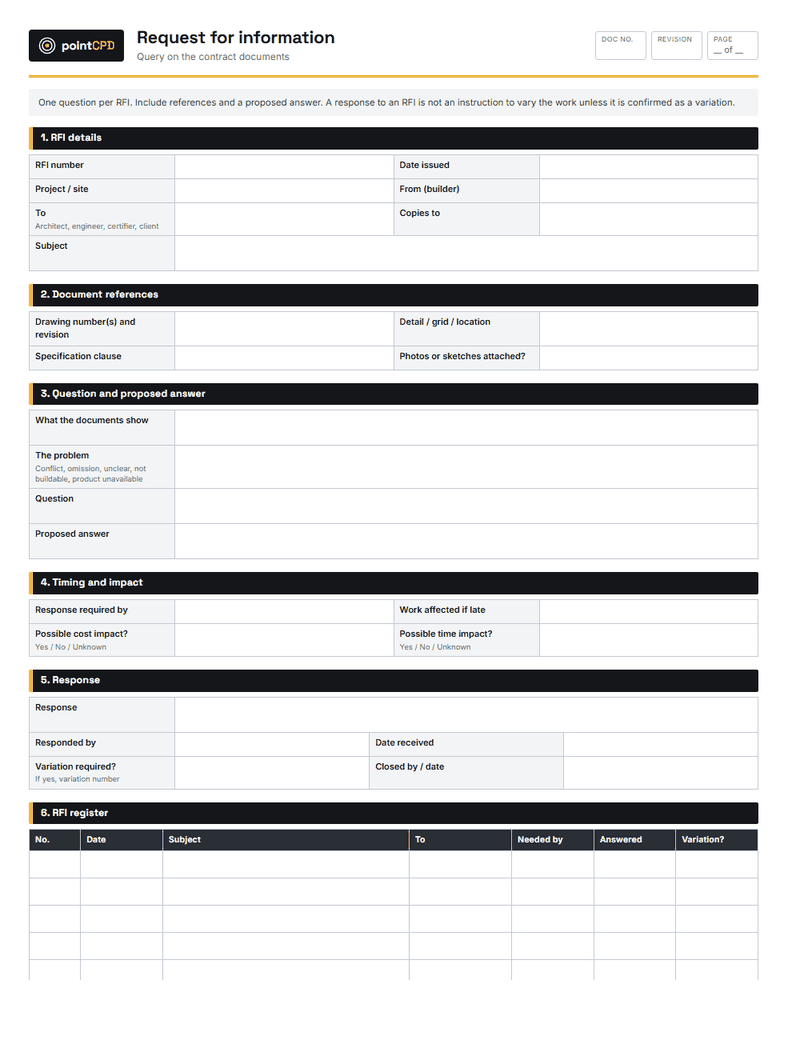
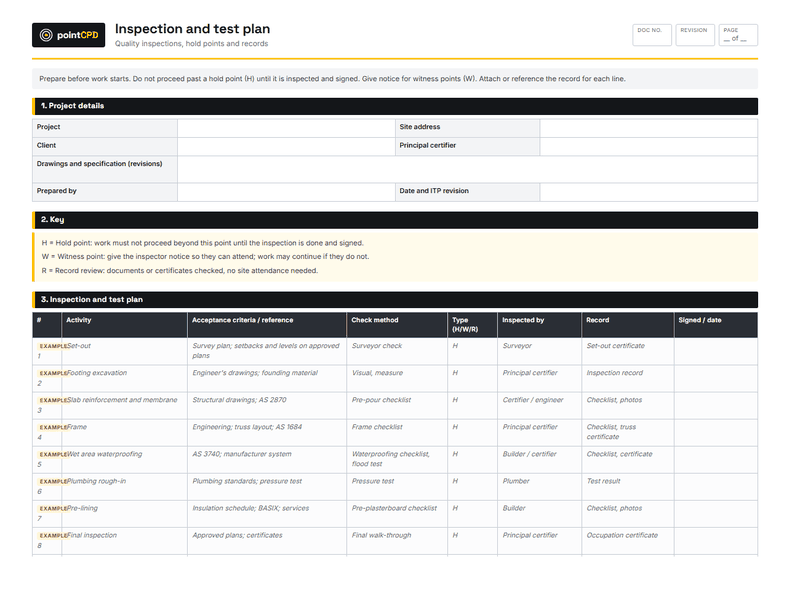
Every substitution should leave a record that someone could follow years later: the product specified, the product used, the reason for the change, the evidence of suitability relied on, who approved it, and when. Keep the data sheets and certificates as they were at the time, because manufacturers update their documents. Photograph the product labels on site. These records support the builder’s position in a defect claim and are exactly the evidence certifiers and, on Class 2 work, the Building Commission expect to see.
The bottom line
Substituting a product is a design decision, a contract decision and a compliance decision, all at once. Check performance for the actual use, get evidence that covers it, consider approvals and BASIX, put it in writing with the owner, and keep the record. Most substitutions are fine. The documentation is what proves it.
Questions builders ask
Can a builder substitute a product that is equivalent to the one specified?
Only if the substitute meets the same performance requirements for the same use, there is evidence of suitability covering that use, and the contract, approvals and any regulated designs allow it. Equivalence must be proved, not assumed.
What is the difference between non-conforming and non-complying building products?
Non-conforming products claim to be something they are not or do not meet the standards required. Non-complying products are used where they do not meet the NCC, laws or standards, even if the product itself is genuine.
What counts as evidence of suitability for a building product?
The NCC lists acceptable forms, including CodeMark certificates, reports from accredited testing laboratories, certificates from qualified professionals and product technical statements. The evidence must cover the specific use.
Does a product substitution need a written variation?
If the product is named in the contract, plans or specification, changing it varies the contract, and NSW residential building contract variations need to be in writing and signed by both parties.
Can a product substitution affect BASIX?
Yes. Changing windows, glazing, insulation or hot water systems can change BASIX commitments, and a revised certificate may be needed before the final inspection.
Sources
- Non-conforming building products · NSW Government
- Evidence of suitability handbook · Australian Building Codes Board
- CodeMark certification scheme · Australian Building Codes Board
Published 6 September 2026. General information for builders, not legal, financial or engineering advice for a specific job. Check current requirements with the relevant regulator or standard before relying on them.