Key takeaways
- Lifting gear should be checked by eye before every use, because the defects that cause failures, such as cuts, kinks, stretched links and worn pins, are visible to a careful person before the load is applied.
- Any item with a missing or illegible rating tag should be treated as unusable until a competent person identifies it and confirms its capacity.
- Gear that fails a check is tagged out and removed from the lifting area at once, because a defective sling left near the work is a sling someone will eventually use.
- Defects should be recorded on a register with the item, the defect, the date and the person who found it, because that record is what shows the check was actually done.
- A repair is only acceptable where the manufacturer requirements allow it and a competent person has assessed the result, and in every other case the gear is replaced before the next lift.
Lifting gear failures rarely come without warning. A sling that parts at the start of a lift usually showed signs of wear days earlier, and a shackle that bends under load was often already distorted when it was taken out of the box or the van. The failure looks sudden because the defect was not looked for, not because it was hidden. The person who sees it first is almost always the one standing next to the gear at the start of the day.
The load goes through every piece of gear in the chain, from the hook on the crane to the sling around the steel or the pallet. Each item has a rated capacity, and damage reduces that capacity, sometimes by an amount no one can judge by looking at it. When the gear fails, the load drops, and the people underneath it, the structure being lifted and anything nearby are exposed. The cost goes well beyond the price of a new sling. The crane sits idle while the investigation runs, the programme slips, the crew stands down and the business that directed the lift carries the consequences.
The organising idea of this article is that gear is only as strong as its weakest defect, and the check that finds the defect takes minutes before the lift. This is about the pre-use check and the removal of faulty gear from service. Planning the lift itself, including the crane, the load path and the exclusion zone, is a separate job, covered elsewhere. A perfectly planned lift will still fail if the sling in it is cut.
The gear in a builder’s rigging kit
A typical residential rigging kit includes wire rope slings, chain slings, synthetic webbing and round slings, shackles, hooks, eye bolts, spreader bars and sometimes a lifting beam or a set of hoist rings. Each piece is rated for a capacity, and the rated capacity depends on how the gear is used. A sling that is rated for a straight vertical lift loses capacity as the angle between its legs opens up, and a two-leg or four-leg configuration is not simply several times the rating of one leg. The configuration on the day is the one that counts, and it should be checked against the tag before the lift starts.
Builders sometimes treat the kit as a single set of tools that all work in the same way. They do not. Wire rope fails differently from chain, and synthetic fibre fails differently from both. A check that looks only for obvious cracks will miss the defects that matter most in the other types of gear. The sections below set out what to look for in each type, so the check is specific rather than a general glance.
What the check looks for, by type of gear
Wire rope slings are checked for broken wires, particularly where the rope bends around a hook, a shackle or a load. A cluster of broken wires in one area, a kink that has been pulled straight, a section that has been flattened or crushed, and signs of corrosion inside the rope all mean the sling is compromised. The splices and the ferrules at the ends are a common point of failure, so they should be checked closely, as should any sign that the rope has slipped in its termination.
Chain slings are checked for stretched links, which look slightly longer than their neighbours and do not sit flat. Nicks and gouges on the surface are defects in their own right, because they create a point where the metal can crack under load. Look for cracks, for twisted links and for wear at the points where the chain bears on the load or on the hook. A chain that has been repaired by welding is not a gear item to use again, and that rule applies whatever the repair looks like.
Synthetic webbing and round slings are checked for cuts and abrasion, which can be deep even when the surface looks clean. Look for fading from long exposure to sunlight, for glazed or melted areas that show heat has reached the fibre, for chemical contact that has softened or discoloured the material and for damage around the stitching and the eyes. Synthetic gear is often damaged in storage or by being dragged across a rough surface, not only during the lift.
Shackles and hooks are checked for distortion of the bow or the body, for a pin that is worn, stretched or not fully seated, and for threads that are damaged or clogged. A hook whose throat has opened up cannot be relied on to hold the load it was rated for, and a latch that does not close properly is a defect that should be taken out of use at once. Shackles should be loaded in line, and a shackle that has been side-loaded, or loaded at an angle it was not designed for, should be assessed before use.
Reading the rating tag and what its absence means
The rating tag shows the rated capacity and the identification of the item, and it is the first thing a rigger should read. A tag that is missing, faded, painted over or cannot be read is a defect in itself. The rating of the gear cannot be assumed from its appearance, and a sling that looks like the one used last week may have a very different capacity. Treat any item with an unreadable tag as unusable until a competent person has identified it and confirmed what it can lift.
A tag also does not prove that the gear is sound. The tag records the rating at the time the item was supplied, and the check on the day establishes whether the item is still in a fit state to be used at that rating. Both checks are needed. The tag tells you what the gear is supposed to do, and the inspection tells you whether it can still do it.
Removal from service and the tag-out that follows
Gear that fails a check must come out of service immediately, and the way that happens matters as much as the decision itself. The steps below set out the sequence a site should follow, from the moment a defect is seen to the moment the replacement is in use. Each step has a clear owner, so the item cannot drift back into the lifting area while the paperwork catches up.
Removing gear from service
- 1Stop the liftLower the load to a safe position, and take the faulty gear out of use before anything else happens.
- 2Tag it outAttach a clear do-not-use tag and move the item away from the usable gear.
- 3Record the defectWrite the item, the defect and the date on the register while the detail is still fresh.
- 4Decide on repair or disposalA competent person decides, and repair is considered only where the manufacturer allows it.
- 5Replace before the next liftReplacement gear is checked, tagged and recorded before it goes into use.
The tag should be clear and visible, and it should say do not use with the date and the name of the person who found the defect. The item should be moved away from the usable gear to a marked location, not left on the deck where someone can pick it up in the hurry of a crane lift. A sling that has been tagged out and then used anyway is a sling that has been used by someone who was told not to, and that is a supervision problem as much as an equipment one.
The decision on repair or disposal belongs to a competent person, and the default should be disposal. Repair is only acceptable where the manufacturer’s requirements allow it and the result can be assessed against the same standard as new gear. A repair carried out on site with whatever is to hand is not a repair in any sense the certifier, the crane operator or the investigator will accept.
The register that proves the check was done
A register is the difference between a site that checks its gear and a site that can prove it. It should record each item with a unique identifier, the type of gear, the date it was supplied or certified, the date of the last inspection and the date of the next one due. Each check should be entered with the name of the person who did it, any defect found and the action taken. The register is the first document an investigator will ask for after an incident, and a gap in it looks like a gap in the check.
The periodic inspection by a competent person sits alongside the daily check. The daily check is the one that catches the defect that appeared overnight or during the previous day’s lifts. The periodic inspection looks at the gear in more depth, at the intervals the manufacturer and the site rules set. Both should be in the register, and the register should show when each one is next due, so nothing is quietly overdue.
Hired, borrowed and subcontractor gear
Gear does not always belong to the builder. A crane hire company may bring its own slings and shackles, a subcontractor may turn up with its own kit, and a rigger may borrow a spreader bar from a mate. All of it is in use on the site, and all of it needs checking before the first lift. The fact that the gear belongs to someone else does not change the duty to check it, and it does not transfer the responsibility for a failure away from the business that directed the lift.
Ask for the certificate or the register entry for hired and subcontract gear, and check the tag against it on the day. A rigger who says the gear is fine without being able to show the tag or the record should be asked to show both before the lift starts. The same discipline applies to the subcontractor’s gear as to your own, and the induction should set out what the site expects. The subcontractor verification steps before work starts, covered in the article on subcontractor WHS verification before start, are a good place to build that expectation in.
Storage and handling that damage gear before it is used
Much of the damage to lifting gear happens between jobs. Slings dragged across concrete, chain thrown into the back of a ute, shackles left in the dirt and synthetic webbing stored in the sun all arrive on site already compromised. Store the gear dry, off the ground and away from chemicals and fuel. Keep synthetic slings out of direct sunlight when they are not in use and cover them if they are stored outside. Hang or rack the gear so it does not rub against sharp edges or against other items.
On the site, the same care applies during the lift. Do not drag a sling across a rough surface, do not use chain as a tie-down for other materials, and do not let a shackle pin rest against a sharp edge where it can be bent. Keep the gear out of the way of welding, grinding and any heat source, because heat can damage synthetic fibre and change the properties of steel. A sling that was damaged by careless handling is a defect like any other, and the register should show it.
Setting the check into the daily site routine
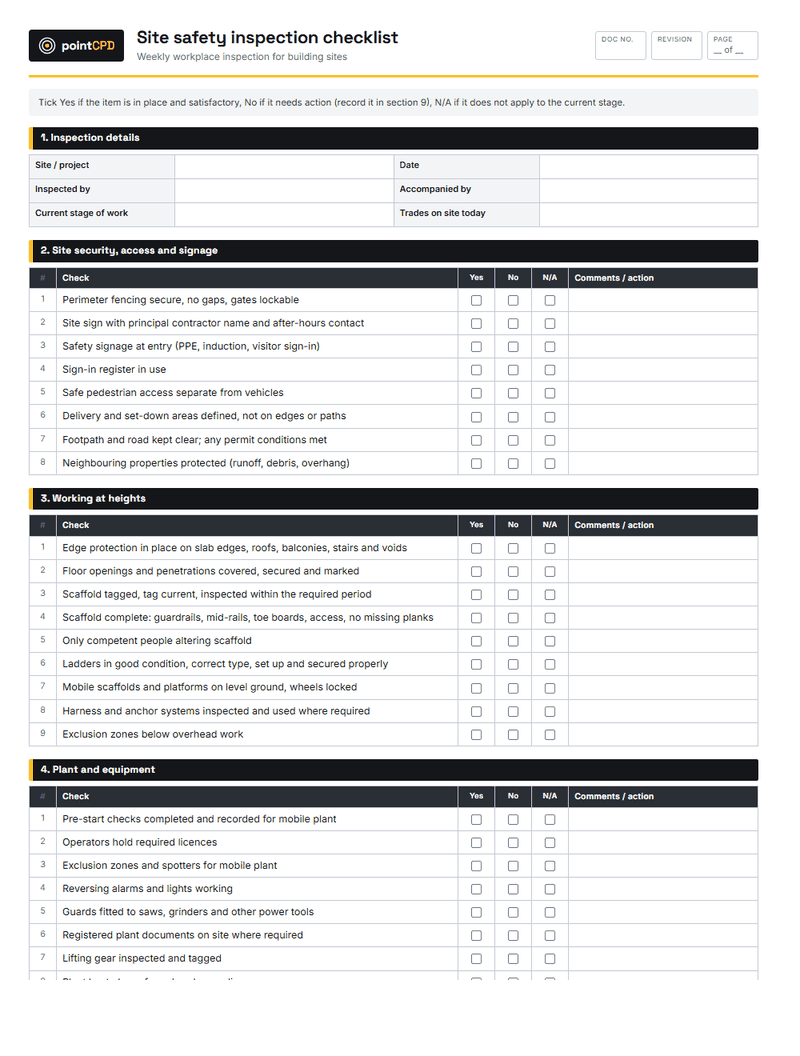
The pre-use check works best when it is part of the routine the crew already follows, rather than a separate task that gets dropped when the programme is tight. A short checklist at the start of the day, completed by the person who will rig the first lift, makes the check specific and quick. The checklist below sets out the points to cover, and the free site safety inspection checklist can be adapted for the site’s own routine.
Before the first lift of the day
- Every sling, shackle and hook has a legible rating tag, and the rating suits the lift.
- No cuts, abrasion, kinks, heat damage or broken strands are visible along the length or at the eyes.
- Shackle pins are fully seated, the threads are clean and the bow is not distorted.
- Chain links are not stretched, nicked or gouged, and no link has been welded or repaired.
- Synthetic slings are free of cuts, fading, chemical contact and damage around the stitching and eyes.
- Any item that fails a check is tagged out and taken away from the lifting area before the next lift.
- The check is recorded against the register, with the name of the person who did it.
The check should be recorded in the same place each day, and the record should be retrievable. A tick on a clipboard in the ute is not a record that will survive an investigation. Put the check into the site diary or the register, so that the first thing an investigator sees is a clear picture of what was checked, by whom and when.
A worked example from a roof framing lift
A builder on the Central Coast is setting roof trusses on a two-storey house, using a hired crane and a rigger who brings his own slings. At the start of the day the rigger runs the check. One of the synthetic round slings has a cut along the edge near the eye, and the tag is faded to the point that the rating cannot be read. The rigger is ready to use it, because the lift is booked and the crane is on the clock.
The builder stops the lift. The sling is taken out of the lifting area, tagged out with the date and the reason, and placed in the marked location. The rigger brings a replacement sling with a legible tag and a current record. The check on the replacement is recorded in the register, and the lift goes ahead about an hour later than planned. The cost is small, and the lift is safer for it. Had the sling been used, the cut would have been the first thing an investigator found.
Lead in. The mistake that costs the most is using a sling with a visible defect because the lift is booked, the crane is on the clock and the defect looks minor. The cut that looks small is the one that fails under load, and the business that used the gear is the one that answers for the failure.
What to do when a defect is found on the day
When a defect is found on the day, the first decision is whether to stop the lift. The answer is almost always yes. Stopping costs time, and the time feels expensive when the crane is hired by the hour and the crew is waiting. The cost of the failure is far higher, and the decision to continue with defective gear is one that nobody wants to be asked to explain. Build the stop into the site routine so the crew knows it is expected, not a sign of weakness.
The article on crane picks in residential work covers how the lift itself is planned, including the load path and the exclusion zone, and it is worth reading alongside this one. The planning and the gear check are two halves of the same job. For a builder wanting the broader picture of how NSW builder CPD works and how the safety topics are recorded, the PointCPD guide to how NSW builder CPD works is the place to start, and the topic areas it sets out include the safety side of the work.
Questions builders ask
How often should slings and shackles be checked?
They should be checked by eye before every use, and inspected in more depth by a competent person at the intervals set by the manufacturer and the site rules. The daily check catches defects that appear overnight or during use. The periodic inspection looks at the gear more closely and is recorded on the register.
Can a sling with a small cut still be used?
Not without a competent person assessing it against the manufacturer requirements. A cut that looks minor can weaken the sling in a way that is not visible, and the safe default is to take the sling out of use and replace it. Repair is only acceptable where the manufacturer allows it.
What should I do if the rating tag on a sling cannot be read?
Treat the sling as unusable until a competent person has identified it and confirmed its capacity. Do not rely on memory or on how it looks. Tag it out, move it away from the usable gear and record the action on the register.
Is hired lifting gear my responsibility?
The business that directs the lift carries responsibility for the gear used on the job, including hired and subcontract gear. Ask for the certificate or the register entry, check the tag against it on the day and record the check. Do not accept a verbal assurance in place of the record.
What is the difference between a shackle that is worn and one that is damaged?
A worn shackle has lost some of its material through use and may still be within its limits, which a competent person must assess. A damaged shackle has a distortion, crack, bent pin or damaged threads that affects its strength. Any shackle with a distorted bow, a stretched or bent pin, or damaged threads should be taken out of use.
How should the lifting gear check be recorded?
Record the check in the site diary or the register, with the item, the date, the name of the person who did it, any defect found and the action taken. Keep the record where it can be retrieved after an incident. A tick on a clipboard that is thrown away is not a record that will survive an investigation.
Sources
- Planning for Bush Fire Protection · NSW Rural Fire Service
- Environmental Planning and Assessment (Development Certification and Fire Safety) Regulation 2021 · NSW Legislation
- Electrical safety · Safe Work Australia
- BASIX · NSW Planning Portal
Published 4 October 2026. General information for builders, not legal, financial or engineering advice for a specific job. Check current requirements with the relevant regulator or standard before relying on them.