A safe work method statement is the one piece of site paperwork the WHS laws name for high-risk construction work. Get it wrong and an inspector can stop the job; get it right and it is the plan your crew actually works to. This template gives you every element the law requires, laid out in the order a supervisor fills it in, with a worked example you can overwrite.
What a SWMS is, and what it is not
A SWMS sets out the high-risk construction work to be done on a site, the hazards that work creates, and the measures that will control the risks. Safe Work Australia describes it as an administrative control: it supports higher-order controls such as edge protection or dust extraction, it does not replace them. A SWMS that says “take care near the edge” while there is no edge protection is paperwork, not a control.
It is also not a procedure manual. The regulator’s own guidance says a lengthy, over-detailed SWMS is hard to understand, apply and monitor. The best ones are short, specific to the site, and written so a worker who has never seen the job can follow them. That is why this template puts the job steps and controls in one table rather than pages of narrative.
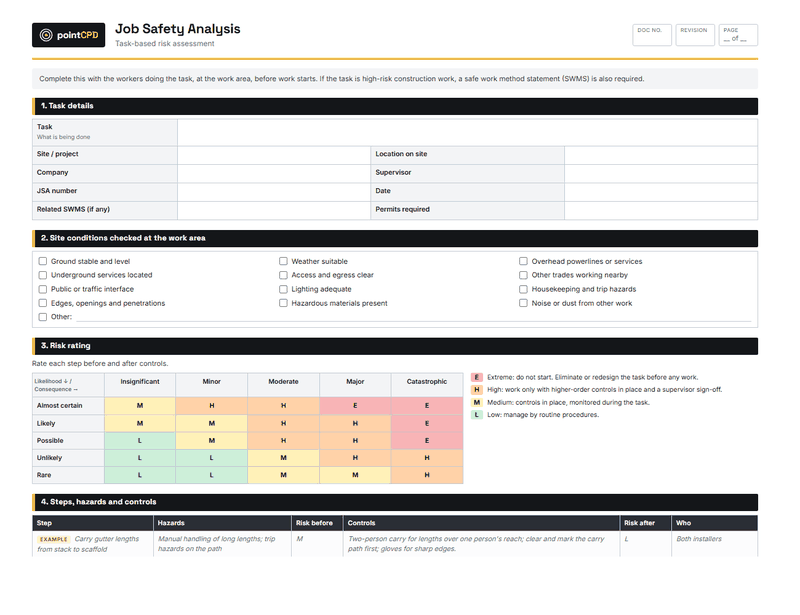
A SWMS is different from a job safety analysis or a safe operating procedure. A JSA can be used for any task; a SWMS is the legal document for the specific kinds of work on the high-risk list.
When you need a SWMS: the high-risk construction work list
Under the model WHS Regulations a SWMS is required before any of 18 high-risk construction work activities starts. In plain terms, the work:
- involves a risk of a person falling more than 2 metres (some jurisdictions use 3 metres);
- is on a telecommunication tower;
- involves demolishing an element that is load-bearing or relates to the physical integrity of the structure;
- involves, or is likely to involve, disturbing asbestos;
- involves structural alterations or repairs that need temporary support to prevent collapse;
- is in or near a confined space;
- is in or near a shaft or trench deeper than 1.5 metres, or a tunnel;
- involves the use of explosives;
- is on or near pressurised gas mains or piping;
- is on or near chemical, fuel or refrigerant lines;
- is on or near energised electrical installations or services;
- is in an area that may have a contaminated or flammable atmosphere;
- involves tilt-up or precast concrete;
- is on, in or next to a road, railway, shipping lane or other traffic corridor in use by traffic other than pedestrians;
- is in an area where there is any movement of powered mobile plant;
- is in an area with artificial extremes of temperature;
- is in or near water or another liquid with a risk of drowning;
- is diving work.
Some jurisdictions have added to this list. The ACT’s 2025 guidance, for example, includes work that processes crystalline silica material with a power tool or other mechanical process, and the template has a tick box for it. Residential builders hit this list constantly: roof work, a scissor lift near a driveway, a trench for stormwater, cutting fibre cement or stone. Check your own regulator’s current list.
A SWMS is not required for work of a minor nature, and it is not required for construction work that is not on the list. You still have a duty to manage every risk so far as is reasonably practicable; the SWMS is simply the document the law specifies for this category.
Victoria runs its own Occupational Health and Safety Regulations rather than the model WHS laws, but it also requires a SWMS before high-risk construction work, with a similar list.
Who prepares it, and what the principal contractor has to do
The business carrying out the high-risk work must prepare the SWMS, or make sure one has been prepared, before the work starts. Safe Work Australia says the person responsible for the work is usually best placed to write it, in consultation with the workers who will do it. In practice that means the builder writes it for their own employees, and each subcontractor writes it for their crew.
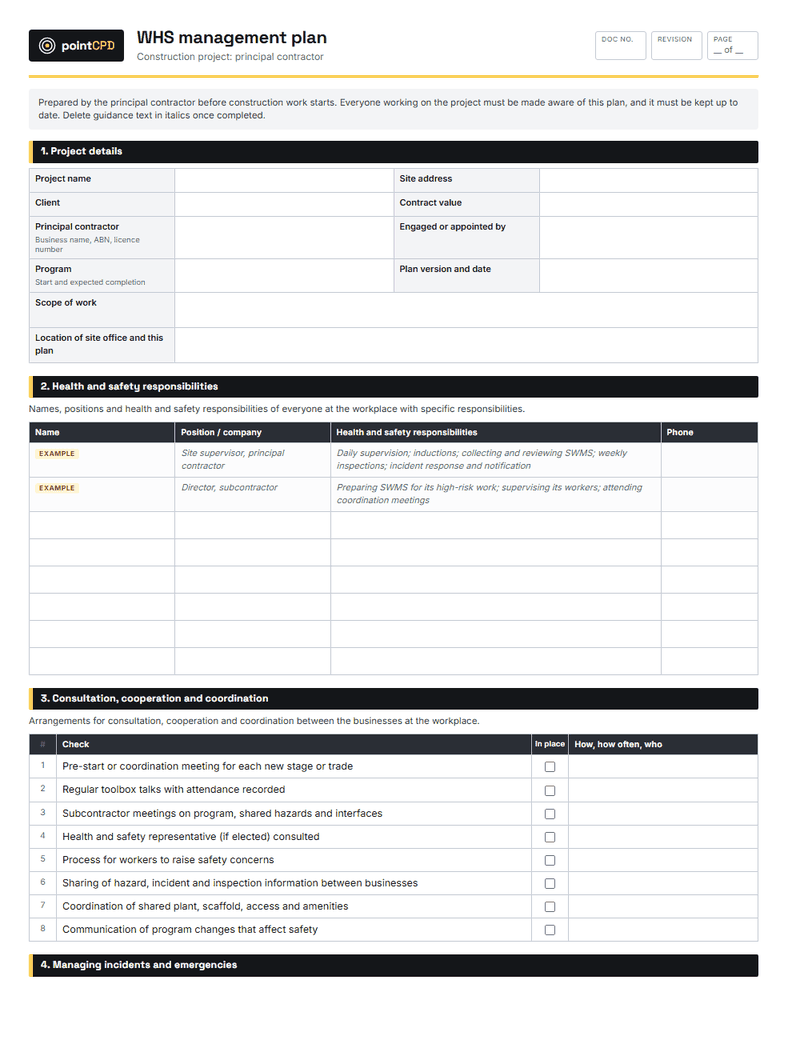
On a construction project, meaning construction work costing $250,000 or more, there must be a principal contractor. The principal contractor must take all reasonable steps to obtain a SWMS from every contractor doing high-risk work before that work starts, and arrange for one to be prepared if it is missing. Their WHS management plan must also say how SWMS will be collected, assessed, monitored and reviewed. The simplest arrangement: no SWMS, no start, written into the subcontract and the site induction. The WHS management plan template has a section for it.
Consultation is not optional. The business must consult the workers doing the work so they understand what the SWMS requires of them, and involve the health and safety representative if there is one. The sign-on sheet at the end of the template is how you evidence it.
What a SWMS must contain
The regulations set four things a SWMS must do. The template maps to each one:
| The law requires the SWMS to | Where it goes in this template |
|---|---|
| Identify the work that is high-risk construction work | Section 2, the high-risk work tick list, and the work activity in section 1 |
| State the hazards and the risks to health and safety | Section 8, hazards and “what could happen” for each job step, rated with the matrix in section 7 |
| Describe the control measures | Section 8 controls column, supported by PPE, plant, competencies and permits in sections 3 to 6 |
| Describe how controls are implemented, monitored and reviewed | Section 11, named people and methods, and the revision record in section 12 |
It must also be easy to understand for the workers using it, including workers from non-English-speaking backgrounds. Pictures, diagrams or a translated copy are all acceptable ways to meet that.
Writing controls that hold up
The controls column is where most SWMS fail. Two rules fix nearly all of it.
Work down the hierarchy of control. Eliminate the hazard if you can: fabricate the truss section on the ground, not at height. If not, substitute (score-and-snap instead of a power saw), isolate (barricade the exclusion zone), or engineer it out (edge protection, dust extraction). Procedures, training and PPE come last, and they back up the higher controls rather than standing alone.
Be specific enough that no one has to decide what you meant. WorkSafe ACT’s guidance uses exactly this example: “use appropriate PPE” is both general and leaves the worker to decide what is suitable.
| Vague (gets rejected) | Specific (holds up) |
|---|---|
| Wear appropriate PPE | P2 disposable respirator, fit-checked at the start of each shift; safety glasses; hearing protection while cutting |
| Take care near edges | Edge protection along the full slab edge, installed and inspected by the supervisor before work starts |
| Be aware of plant | Exclusion zone of barriers and signage around the excavator swing radius; spotter with radio contact while it is working |
| Use safe work practices | Isolate the circuit at the switchboard, lock and tag it, and test for dead before touching conductors |
Generic SWMS: where they fail
Buying a pack of “compliant” SWMS and signing them unchanged is the most common way builders end up with paperwork that does not protect anyone. A SWMS has to reflect the actual workplace, the work environment and the workers. Safe Work Australia is explicit that a generic SWMS used across sites may not meet the law unless it is reviewed and changed for each one.
Use this template as the frame, then make it yours: this site’s access, this slope, these overhead powerlines, this neighbour’s driveway. If you prepare separate SWMS for different activities, check where they interact, for example a mobile crane lift while roofers are on the frame.
Keeping it, reviewing it, and stopping work
High-risk construction work has to be carried out in accordance with the SWMS. If it is not, the work must stop immediately or as soon as it is safe, and must not restart until it can be done as the SWMS says. That rule is printed at the top of the template so no one can say they did not know.
Review and revise the SWMS whenever the control measures change, and at the triggers written into section 11: a change of method, site conditions or crew, an incident or near miss, or a control that is not working. When it is revised, tell everyone involved, give the principal contractor the new version, and re-brief the workers.
Keep the SWMS on site, or where it can be brought to site quickly, until the work is finished. Keep every revision. If a notifiable incident occurs in connection with the work, keep it for at least two years from the date of the incident.
Mistakes that get work stopped
- No SWMS until the inspector asks. It must exist before the high-risk work starts, and the principal contractor must have it.
- Controls that are really hopes. “Care”, “awareness” and “appropriate” are not controls. Name the equipment, the barrier, the person.
- A SWMS the crew has never seen. If the workers cannot tell you what it says, it is not being followed. Brief it, and get sign-on.
- The job changed, the SWMS did not. A different scaffold, a new sub, rain on a clay site: review it.
- Everything on the list ticked “just in case”. It hides the work that actually matters. Tick what applies, and control it properly.
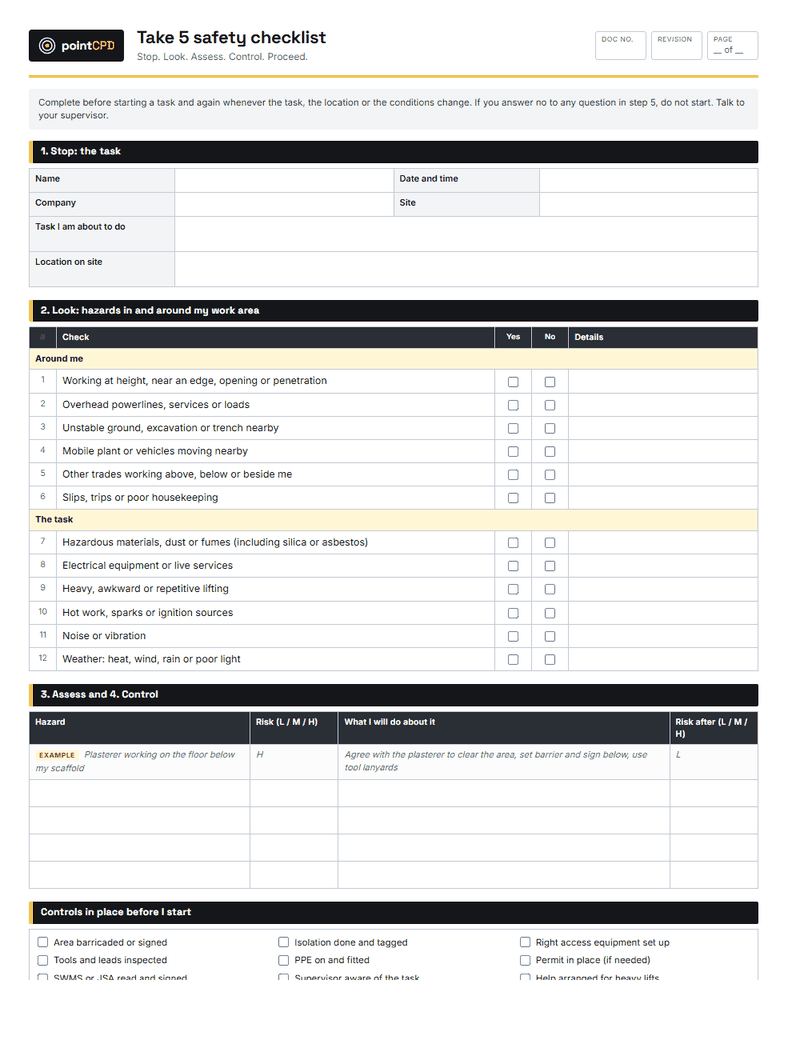
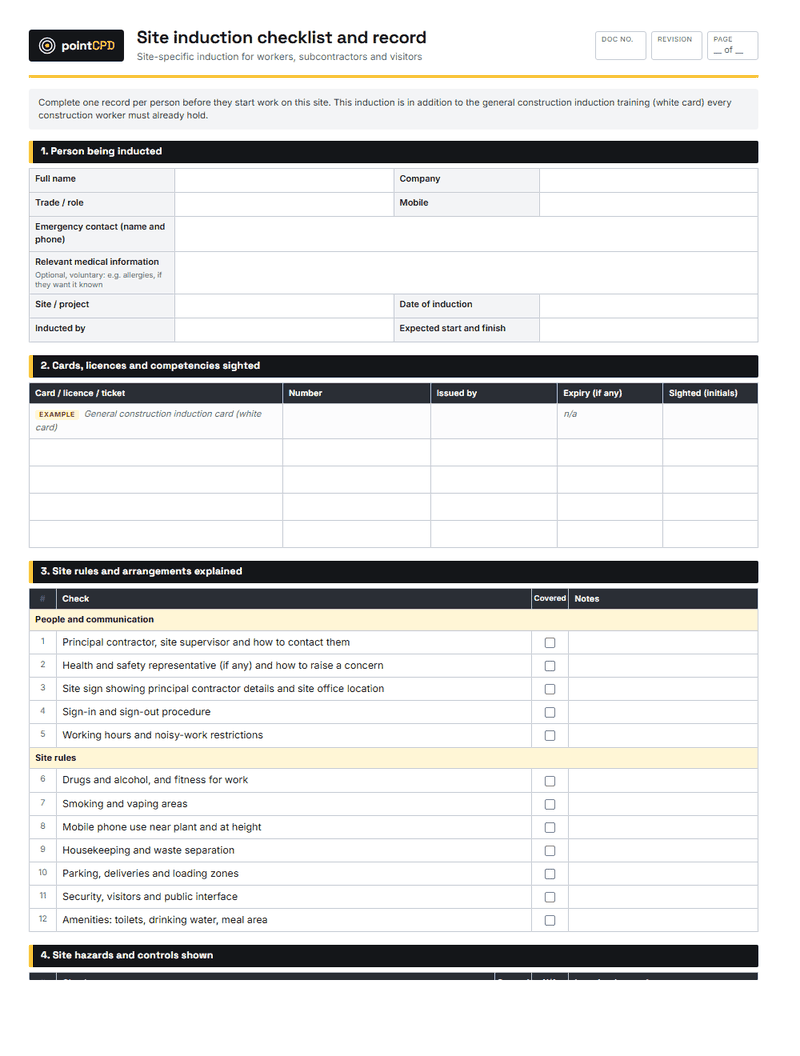
For the other paperwork that sits around a SWMS, use the Take 5 for the pre-task check, the toolbox talk record to brief the crew, and the site induction checklist before anyone starts.