Skip to content
  • NSW-first CPD, built by a practising builder
  • Instant PDF certificates
  • Unlimited assessment attempts
  • 12 points a year, sorted
  • 15% off your first order — get your code
  • Content aligned to the NCC 2022

Free template Contracts and site admin

Free construction site diary template (daily site report)

A one-page daily record of the job: weather, who was on site, work completed, deliveries, delays, instructions, visitors and inspections, safety and photos. The evidence behind every claim.

The short version

A site diary is a daily, contemporaneous record of the job: weather, labour and trades on site, work done, deliveries, delays and their causes, instructions received, visitors and inspections, safety events and photos. Fill it in every day, the same day. It is the best evidence a builder has for extension of time claims, variations, disputes and defect claims, because records made at the time carry far more weight than memory.

  • No sign-up
  • Free for commercial use
  • Add your own logo
  • Updated 14 Sep 2026

Reviewed by Daniel Betros, Licensed Building Practitioner

Animated walkthrough · 7 steps

How to keep a site diary

Seven entries a day, written the same day. Five minutes at knock-off is enough.

1 / 7
  1. Record the date, site hours and weather, including rain that stopped work and when. Weather is the most common basis for extension of time claims.

  2. Your people and each trade, with numbers and hours. It proves progress, explains delays and is needed for any labour-based variation.

  3. What was completed today, by area. Short and specific: "Level 1 wall frames east side stood and braced".

  4. Materials and plant delivered, anything late or wrong, and every delay with its cause and the time lost.

  5. Any instruction from the owner, architect or certifier, especially verbal ones, visitors, and inspections done. Verbal instructions are where variation disputes begin.

  6. Toolbox talks, inspections, incidents, near misses and hazards, cross-referenced to the reports.

  7. Reference the day's photos and sign the entry. A signed, dated entry made that day is hard to argue with.

When a dispute reaches a tribunal or an adjudicator, the builder with a daily site diary usually wins the argument about what happened. The builder without one is relying on memory against the other side’s emails. A site diary takes five minutes at the end of the day. This template puts everything worth recording on one page.

Why contemporaneous records matter

A record made on the day, by someone who was there, carries far more weight than a reconstruction made months later. That is the whole value of a site diary. It is the evidence behind extension of time claims, variation claims, payment disputes, defect claims and insurance claims, and it protects against the common problem of the owner, the architect and the builder each remembering a different conversation.

What to record, and why each part earns its place

EntryWhat it proves later
Weather and site conditionsWet weather delays and lost days, the most common basis for extension of time
Labour and tradesWho was working, progress rates, and the labour behind a variation
Work completedProgress for payment claims and program updates
Deliveries and delaysLate or wrong materials, and the time lost, with its cause
Instructions and visitorsOwner and consultant instructions, especially verbal ones, and inspections
SafetyConsultation, inspections, incidents and hazards
PhotosVisual evidence of progress, conditions and work before it was covered

Write it like evidence

  1. Same day, every day. Including days nothing happened: “site closed, rain from 6am” is evidence.
  2. Facts, not opinions. “Plumber did not attend as booked”, not “plumber useless again”.
  3. Specific. Times, areas, names, quantities.
  4. Never rewrite. Add a dated note if something needs correcting. Changed entries undermine the whole diary.
  5. Signed. A signature and date make it a record rather than a note.

Verbal instructions: the most valuable line in the diary

Owners change their minds on site. Consultants give instructions in passing. Those conversations become disputes when the invoice arrives. Record every instruction in section 5, and confirm significant ones in writing the same day, as a variation or an RFI. In NSW residential work, variations need to be agreed in writing, so the diary entry is the prompt to get the paperwork signed before the work is done.

Delays and extensions of time

An extension of time claim has to show that a delay happened, what caused it, and how it affected completion. Most contracts also require notice within a set time. The diary supplies the evidence: rain start and stop times, the trade that could not work, the late delivery, the owner’s instruction that stopped a trade. Without daily records, an EOT claim is an argument; with them, it is a calculation.

Paper or app?

Either works. Many builders now use a phone app or a shared spreadsheet, which makes photos easy and backs everything up. Whatever the format, the rules are the same: dated entries, made on the day, not silently edited later. The PDF version of this template prints as a daily pad; the Word version can be adapted into a digital form.

Keep it for years

Residential defect claims can surface years after handover, within statutory warranty periods. Keep site diaries with the project records for at least as long as claims could be made, alongside the payment claims, variations and handover documents they support.

What a good entry looks like

A useful diary entry is short, factual and specific. For example:

Tuesday. Site 7am to 3.30pm. Fine morning; rain from 12.40pm, heavy until 2.15pm; site too wet to continue earthworks. On site: own carpenters (2) framing level 1 east; plumber (1) stormwater, stopped at 12.40pm due to rain; bricklayers did not attend as booked (supervisor called 7.30am, no answer). Delivered: level 1 floor trusses 9am, checked against order, one damaged, supplier notified. Owner on site 10.30am, asked to move kitchen window 300 mm left: told a variation would be issued; V07 sent 2pm. Toolbox talk 7am: working at heights on level 1, 8 attendees. Photos 1123 to 1140.

Every fact in that entry could matter later: the rain for an extension of time, the missing bricklayers for the program, the damaged truss for the supplier, and the owner’s instruction for the variation.

Diaries in disputes

When a dispute reaches an adjudicator, NCAT or a court, contemporaneous records are given significant weight because they were made before anyone knew there would be a dispute. A diary that is complete, dated and consistent is persuasive. A diary with gaps, entries clearly written later, or changes that are not explained is much less so, and can damage the credibility of everything else. That is why the rules in this guide matter: same day, factual, never rewritten. It is also why the diary should be kept by someone on site every day, not reconstructed at the end of the week.
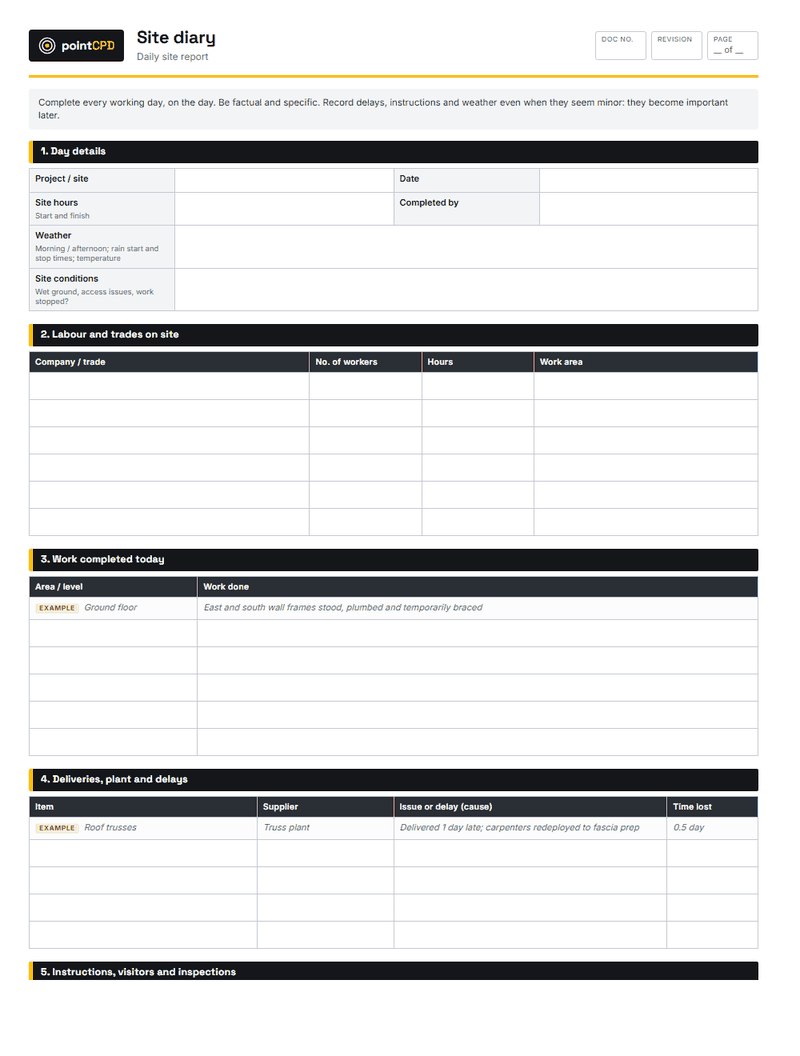
Preview the full Site diary (daily site report) template

Every section, field and check in the download, exactly as it prints. Edit the Word version to add your logo, delete what does not apply and add your own site-specific items.

pointCPD

Site diary

Daily site report

Doc no.
Revision
Page
__ of __

Complete every working day, on the day. Be factual and specific. Record delays, instructions and weather even when they seem minor: they become important later.

1. Day details

Project / siteDate
Site hoursStart and finishCompleted by
WeatherMorning / afternoon; rain start and stop times; temperature
Site conditionsWet ground, access issues, work stopped?

2. Labour and trades on site

Company / tradeNo. of workersHoursWork area

3. Work completed today

Area / levelWork done
ExampleGround floorEast and south wall frames stood, plumbed and temporarily braced

4. Deliveries, plant and delays

ItemSupplierIssue or delay (cause)Time lost
ExampleRoof trussesTruss plantDelivered 1 day late; carpenters redeployed to fascia prep0.5 day

5. Instructions, visitors and inspections

Record every instruction, especially verbal ones. Confirm significant instructions in writing the same day.

TimeFrom / visitorInstruction, discussion or inspectionFollow-up (variation, RFI)
Example10:30OwnerAsked to move kitchen window 300 mm leftVariation request V07 issued

6. Safety

#CheckYesNoDetails / report reference
1Toolbox talk or pre-start held
2Site inspection done
3New workers inducted
4Incident or injury
5Near miss
6Hazard reported
7Regulator, council or certifier visit

7. Photos and sign-off

Photo numbers / folder
Notes for tomorrow
SignatureDate
Template by PointCPD · pointcpd.com.au/resources/templates/site-diary-template/Free to use, copy and adapt, including commercially (CC BY 4.0). Keep this credit line.v1.0

Download Word Download PDF

Questions builders ask

Why keep a site diary?

Because records made at the time are the strongest evidence in any dispute about delays, variations, payment or defects. A site diary also improves day-to-day management by showing what happened and why.

What should go in a site diary?

Weather, site hours, labour and trades, work completed, deliveries and plant, delays and their causes, instructions and visitors, inspections, safety events and photo references.

Is a digital site diary acceptable?

Yes. Apps and spreadsheets work well if entries are dated and cannot be silently changed later. Whatever the format, the key is a daily entry made on the day.

How does a site diary help with extension of time claims?

An EOT claim needs to show a qualifying delay, its cause and its effect on completion. Daily weather, delay and labour records are the evidence. Without them, claims come down to memory.

Should verbal instructions go in the diary?

Yes, always, and significant ones should be confirmed in writing the same day, ideally as a variation or RFI. Unrecorded verbal instructions are the source of many variation disputes.

How long should site diaries be kept?

At least as long as any claim could be made about the work, which for residential work in NSW can be many years given statutory warranty periods. Keep them with the project records.

Free to use, adapt and share, including commercially

This template is licensed under Creative Commons Attribution 4.0. Copy it, rebrand it, edit it for your jobs, hand it to clients and subcontractors, or republish it. The one condition: keep the small PointCPD credit line on the document. If you publish it online, credit it like this:

<a href="https://pointcpd.com.au/resources/templates/site-diary-template/">Site diary (daily site report) template</a> by PointCPD, CC BY 4.0

Last reviewed 14 September 2026. A template is a starting point: it becomes a compliant document only once it is completed for the actual job by people who understand the work, and kept current as the work changes. General information, not legal advice. Check the requirements of your state regulator and your contract.

Sources: Good practice for construction record keeping. Your building contract sets notice and record requirements for delays and variations; statutory warranty periods under the Home Building Act 1989 (NSW) affect how long records remain relevant.