Skip to content
  • NSW-first CPD, built by a practising builder
  • Instant PDF certificates
  • Unlimited assessment attempts
  • 12 points a year, sorted
  • 15% off your first order — get your code
  • Content aligned to the NCC 2022

Free template Inspections and quality

Free waterproofing inspection checklist for wet areas and balconies

The pre-cover check for wet areas and balconies: substrate, falls, membrane extent, junctions, penetrations, flood test and the waterproofer's certificate, before any tile goes down.

The short version

Before tiling, check the substrate, the falls to the waste, the membrane extent up walls and across floors, every junction and penetration, and the flood test, against AS 3740 for internal wet areas (or the external waterproofing requirements for balconies) and the membrane manufacturer's instructions. Photograph it and get the waterproofer's certificate. Once tiles are down, none of it can be checked without demolition.

  • No sign-up
  • Free for commercial use
  • Add your own logo
  • Updated 14 Sep 2026

Reviewed by Daniel Betros, Licensed Building Practitioner

Animated walkthrough · 6 steps

How to inspect waterproofing before tiling

Six steps. Do it when the membrane has cured and before the tiler is booked to start.

1 / 6
  1. Which room or balcony, the membrane product and system, the waterproofer and their licence, and the date applied. Check the product suits the substrate and the use.

  2. Clean, dry, sound and cured substrate, primed as the manufacturer requires. Damp or dusty substrate is the most common cause of membrane failure and voids most warranties.

  3. Floors fall to the waste with no ponding, puddle flanges and waste outlets correctly installed, and balcony drainage and overflow provided.

  4. Membrane covers the floor and runs up walls to the heights AS 3740 requires for each zone, with consistent colour and coverage and no pinholes or thin spots.

  5. Wall-floor junctions, bond breakers, corners, shower hobs or set-downs, door thresholds, water stops and pipe penetrations. This is where nearly every failure starts.

  6. Flood test where specified, check for leaks below, photograph every junction, get the waterproofer's certificate and record the inspection before the tiler starts.

Waterproofing is one of the most expensive defect categories in residential building, and almost every failure is invisible until it is a stain on the ceiling below or tiles lifting a year after handover. By then the fix is a strip-out. The pre-cover inspection is the only moment the membrane can be checked at all. This checklist covers it for bathrooms, laundries and balconies.

The standards behind the checklist

For internal wet areas, the National Construction Code references AS 3740 Waterproofing of domestic wet areas. It sets where waterproofing is required in each zone of a wet area, how far membranes run up walls, what happens at junctions and penetrations, and the falls that stop water ponding. External balconies and decks fall under separate external waterproofing requirements, and every membrane system has its own manufacturer’s instructions for substrate, primer, thickness and curing. The checklist states no heights or overlaps: check those against the current standard and the system you are using. Our AS 3740 guide explains what the standard covers in plain terms.

Where failures actually start

The flat field of a membrane rarely fails. The junctions and the substrate do. A wall-floor junction without a bond breaker cracks as the building moves. A puddle flange not lapped into the membrane lets water bypass it. A door threshold without a water stop leaks into the hallway. A membrane rolled onto damp or dusty screed never bonds. That is why section 4, junctions and penetrations, is the longest part of the checklist, and why section 2 starts with the substrate.

Falls: the cheapest test there is

Water that does not drain eventually finds a way through. Check the floor falls to the waste with no ponding before the membrane goes on, and again after. On balconies, falls must run away from the building to outlets, with an overflow so a blocked outlet does not flood the room inside. A bucket of water and a few minutes will show you what a spirit level misses.

Flood testing

Where it is specified, or where there is any doubt, flood test the membrane before tiling: plug the waste, fill the area to a set depth, and check below for leaks during and after the test. It costs a day. A leak found after tiling costs the whole room.

Who is responsible

The waterproofer warrants their work, and in NSW waterproofing is licensed work, so check the licence before engaging them. But under most residential building contracts, the builder is responsible to the owner for defects in the work, whoever did it. When a waterproofing defect appears during the statutory warranty period, the builder’s own pre-cover inspection, with dated photos of every junction and the waterproofer’s certificate, is what shapes the outcome. Our guide to balcony and wet-area waterproofing defects covers the cost and claim patterns.

Mandatory inspections

The NSW principal certifier’s mandatory critical stage inspections include waterproofing of wet areas before it is covered for certain building classes. Check your certifier’s inspection schedule for the job and book it before the tiler, not after.

Protect it after inspection

A membrane passed on Monday can be damaged by Tuesday: a dropped tool, a wheelbarrow, a tiler’s trowel scraping the upturn. The sign-off asks for the tiler to be told the membrane must not be damaged, and any damage repaired and re-inspected before it is covered. Record the inspection in the inspection and test plan as a hold point that the tiling cannot pass without.

Balconies: the details that fail

Balconies over living spaces are among the highest-risk waterproofing details in residential construction, because they are exposed to weather, often have shallow falls, and sit over rooms where a leak does the most damage. The checks that matter most:

  • Threshold: the step-down or threshold detail at the door, and the membrane turned up behind the sill as the system details it.
  • Falls and outlets: falls away from the building to outlets, with an overflow so a blocked outlet does not flood inside.
  • Upturns: membrane carried up walls and behind cladding, with flashings lapped correctly over it.
  • Balustrade fixings: posts and brackets that penetrate the membrane sealed as the system requires, or fixed through the face instead of the floor.

Our guide to balcony waterproofing defects covers why these fail and what the repairs cost.

Renovation bathrooms

Bathroom renovations bring waterproofing risks that new builds do not: existing substrates of unknown condition, timber floors that move more than slabs, old wastes at the wrong height, and junctions with existing walls. Strip back to a sound substrate, fix or replace flooring so it is stable, set wastes and falls correctly rather than working around the old ones, and follow the membrane system’s requirements for timber substrates. Renovation work is where shortcuts are most tempting and where the same inspection matters most.
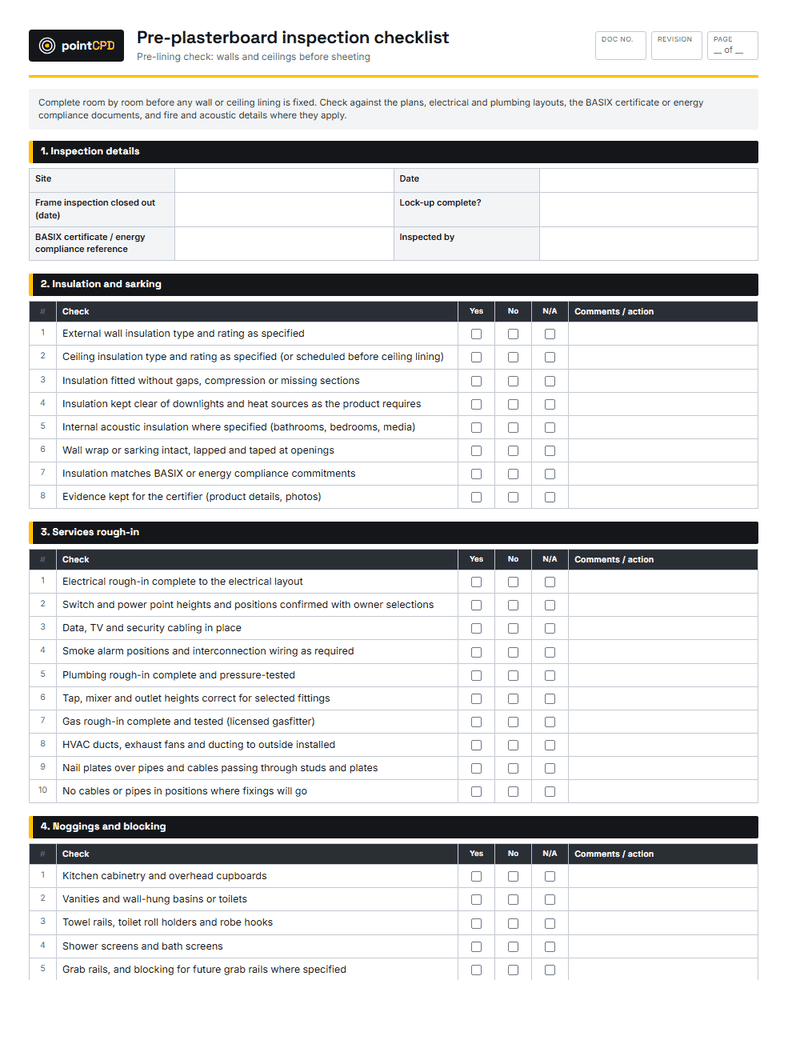
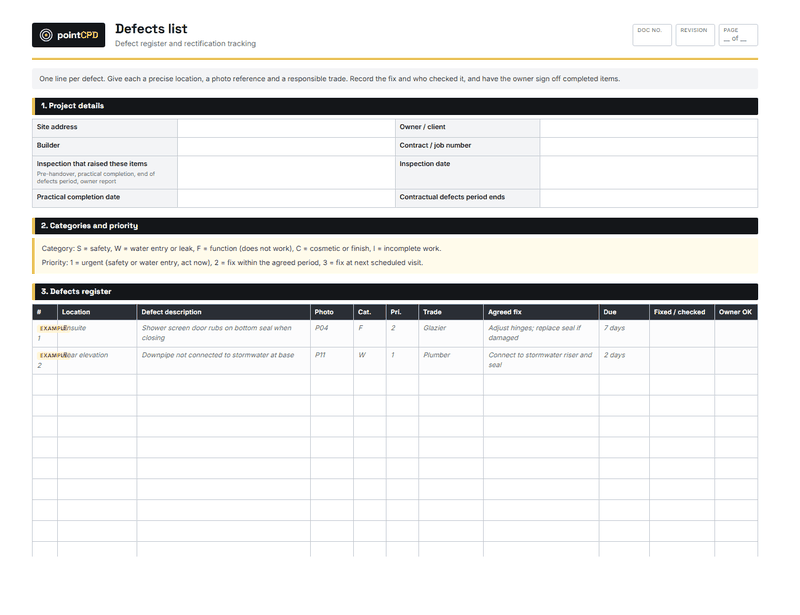
Preview the full Waterproofing inspection checklist template

Every section, field and check in the download, exactly as it prints. Edit the Word version to add your logo, delete what does not apply and add your own site-specific items.

pointCPD

Waterproofing inspection checklist

Internal wet areas and external balconies: before covering

Doc no.
Revision
Page
__ of __

Inspect after the membrane has cured and before any screed, bedding or tiles are laid. Check against AS 3740 (internal wet areas), the external waterproofing requirements for balconies and decks, and the membrane manufacturer's instructions. One checklist per wet area.

1. Area and system

SiteAreaEnsuite, bathroom, laundry, WC, balcony
Membrane product and systemMembrane typeLiquid, sheet; under or over screed
WaterprooferLicence number
Date appliedCuring time per manufacturer

2. Substrate, falls and drainage

#CheckYesNoN/AComments / action
1Substrate clean, dry, sound and cured before membrane applied
2Substrate type compatible with the membrane system
3Primer applied as the manufacturer requires
4Floor falls to the waste as designed, no ponding
5Shower area set-down or hob as designed
6Puddle flanges fitted and sealed into the membrane
7Waste outlets at the correct height
8Balcony: falls away from the building, outlets and overflow provided
9Balcony: threshold height or step-down as designed

3. Membrane extent and application

#CheckYesNoN/AComments / action
1Floor fully waterproofed where required for the area
2Shower area walls waterproofed to the required height and width
3Walls outside the shower treated as required (splash zones, wall-floor junction)
4Bath and spa surrounds treated as required
5Membrane continuous with consistent colour and coverage
6Applied at the manufacturer's thickness (wet film or coats as specified)
7No pinholes, blisters, thin spots or damage
8Reinforcing fabric installed where the system requires it

4. Junctions and penetrations

#CheckYesNoN/AComments / action
1Bond breakers or flexible sealant at wall-floor and wall-wall junctions
2Internal and external corners reinforced as the system requires
3Membrane overlaps at junctions as required
4Water stop angle at the shower or wet area perimeter and door threshold
5Membrane lapped onto water stops and puddle flanges
6Pipe penetrations sealed with collars or flanges
7Tap and mixer penetrations sealed
8Balcony: membrane turned up behind door sill and under cladding as detailed

5. Flood test and evidence

Flood test done?Where specifiedDuration and result
Checked below for leaks byPhotos of every junction taken?
Waterproofer's certificate received (date)Certifier inspection (if required)

6. Defects and rectification

LocationDefectActionRe-checked (date)

7. Released for tiling

Inspected bySignature
DateTiler told membrane must not be damaged
Template by PointCPD · pointcpd.com.au/resources/templates/waterproofing-inspection-checklist/Free to use, copy and adapt, including commercially (CC BY 4.0). Keep this credit line.v1.0

Download Word Download PDF

Questions builders ask

What standard covers waterproofing of wet areas?

AS 3740 Waterproofing of domestic wet areas, referenced by the National Construction Code, for internal wet areas such as bathrooms and laundries. External balconies and decks fall under separate external waterproofing requirements. The membrane manufacturer's instructions also apply.

Should a shower be flood tested?

Where it is specified, or where there is any doubt about the membrane, a flood test before tiling is the simplest way to find a leak while it is still cheap to fix. Check below the area during and after the test.

Where do waterproofing failures usually start?

At junctions and penetrations rather than in the flat field: wall-floor junctions, corners, door thresholds, pipe penetrations and puddle flanges, and on substrates that were damp or dusty when the membrane went on.

Who is responsible for waterproofing defects?

The waterproofer warrants their work, but under most residential building contracts the builder is responsible to the owner for defects in the work. The builder's own inspection before the membrane is covered is what protects them.

Is waterproofing a mandatory inspection in NSW?

The NSW principal certifier's mandatory critical stage inspections include waterproofing in wet areas before it is covered for some building classes. Check your certifier's inspection schedule for the job.

Does a waterproofer need a licence in NSW?

Waterproofing is licensed work in NSW above the general licensing threshold. Check the licence on the NSW Government licence check before engaging them.

Free to use, adapt and share, including commercially

This template is licensed under Creative Commons Attribution 4.0. Copy it, rebrand it, edit it for your jobs, hand it to clients and subcontractors, or republish it. The one condition: keep the small PointCPD credit line on the document. If you publish it online, credit it like this:

<a href="https://pointcpd.com.au/resources/templates/waterproofing-inspection-checklist/">Waterproofing inspection checklist template</a> by PointCPD, CC BY 4.0

Last reviewed 14 September 2026. A template is a starting point: it becomes a compliant document only once it is completed for the actual job by people who understand the work, and kept current as the work changes. General information, not legal advice. Check the requirements of your state regulator and your contract.

Sources: AS 3740 Waterproofing of domestic wet areas (Standards Australia; not reproduced). National Construction Code, Housing Provisions (wet areas and external waterproofing). Environmental Planning and Assessment Regulation 2021 (NSW), critical stage inspections. See also our guides to AS 3740 and balcony waterproofing defects.